
 Varad
Varad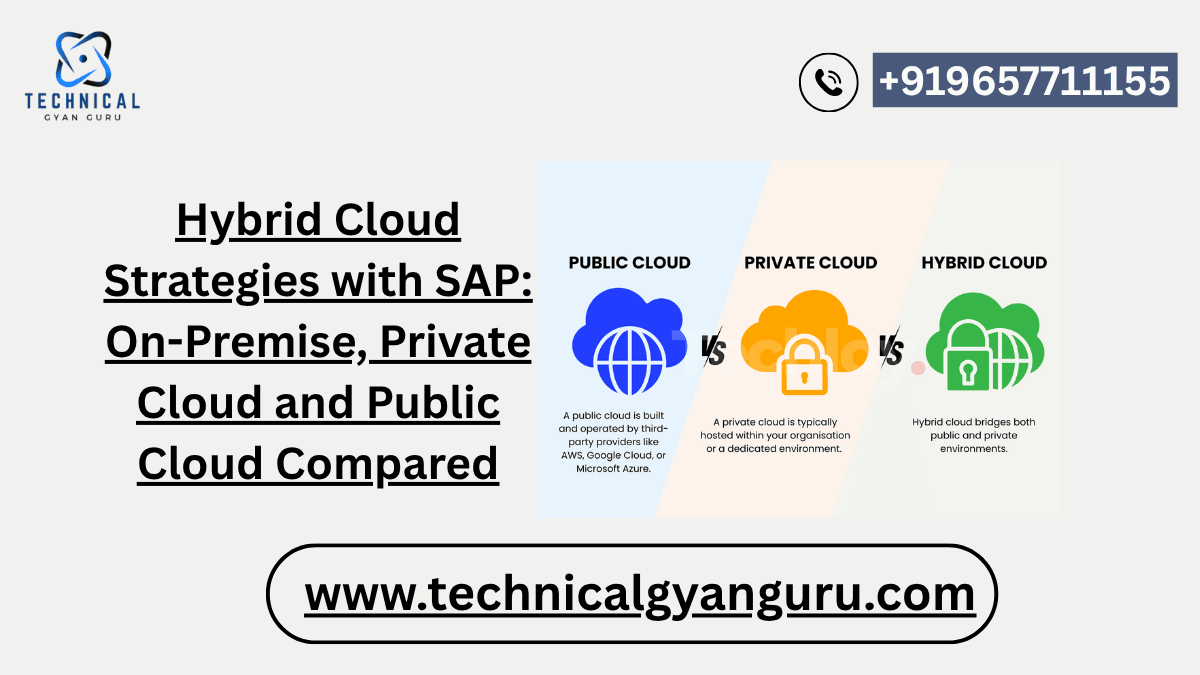
In today’s digital economy, the race to transform business operations has become a matter of survival. Enterprises no longer question whether to move to the cloud—they’re deciding how to do it most effectively. While some organizations embrace a full public cloud transition, others prefer to maintain control over their critical data through on-premise or private cloud setups. Many, however, find the perfect balance in Hybrid Cloud Strategies with SAP, a model that combines flexibility, scalability, and governance without compromising on performance or compliance.
SAP, one of the world’s leading enterprise software providers, has been at the forefront of this cloud transformation. Through its hybrid approach, SAP empowers organizations to blend the best of both worlds—leveraging on-premise systems for stability and compliance while taking advantage of cloud solutions for innovation and agility. Understanding how these environments interact is key for any business aiming to modernize its infrastructure while maintaining operational continuity.
Let’s start with the fundamentals. A hybrid cloud model refers to an IT architecture that integrates on-premise systems with private and public cloud environments, allowing data and applications to move seamlessly between them. For businesses running SAP systems, this model is particularly powerful because it enables them to retain mission-critical workloads on-premise—such as ERP systems—while offloading analytics, AI, or non-sensitive workloads to the cloud. The result is an optimized landscape that reduces costs, enhances agility, and supports continuous innovation.
The Role of On-Premise in Hybrid Cloud Strategies with SAP remains vital, even in an increasingly cloud-first world. On-premise systems have long been the backbone of enterprise IT, offering unmatched control over infrastructure, data security, and compliance. Many industries—like finance, healthcare, and government—still rely heavily on on-premise SAP systems due to regulatory requirements or sensitive data protection needs. These systems provide stability and allow businesses to customize their SAP environments extensively. However, the trade-off often comes in the form of slower scalability and higher maintenance costs.
This is where the private cloud enters the picture. A private cloud setup offers many of the same advantages as on-premise systems—control, security, and customization—while adding the flexibility of cloud technology. SAP’s private cloud offerings, such as SAP S/4HANA Cloud, private edition, allow companies to modernize their infrastructure without fully migrating to a public environment. Private cloud deployments are ideal for organizations that want the benefits of automation and scalability but need to maintain strong governance over data. SAP manages the underlying infrastructure, while customers retain control over application management and configuration, ensuring a balance between convenience and compliance.
The public cloud, meanwhile, represents the next stage in SAP’s digital transformation ecosystem. With SAP S/4HANA Cloud, public edition, businesses gain access to a fully managed, subscription-based service where SAP handles the infrastructure, updates, and scalability. Public cloud deployments are especially appealing for organizations seeking rapid innovation, lower total cost of ownership, and easier access to emerging technologies such as machine learning, predictive analytics, and artificial intelligence. By running in a public cloud environment, businesses can adopt new SAP capabilities faster and focus their resources on business outcomes rather than IT maintenance.
When comparing on-premise, private, and public cloud in the SAP context, each model serves a unique purpose within the hybrid strategy. On-premise offers control and stability; private cloud ensures flexibility with compliance; and public cloud provides scalability and innovation at speed. The hybrid model brings them all together—allowing businesses to run their core ERP systems on-premise or in a private cloud, while connecting analytics, customer experience, and supply chain management applications in the public cloud. This interconnected approach ensures real-time data sharing and unified business intelligence across the enterprise.
A real-world example can make this clearer. Consider a global manufacturing company running its SAP S/4HANA ERP system on-premise for production and inventory management due to strict operational control requirements. At the same time, it uses SAP Analytics Cloud in a public cloud environment to analyze data and create forecasts across regions. Meanwhile, a private cloud hosts the HR and compliance modules to ensure privacy. This setup allows the organization to remain agile, secure, and data-driven—all while avoiding the pitfalls of being locked into a single environment.
Beyond flexibility, one of the biggest advantages of Hybrid Cloud Strategies with SAP is cost optimization. Instead of investing heavily in on-premise hardware upgrades or paying for full-scale public cloud services, businesses can allocate resources dynamically. For instance, seasonal spikes in demand can be managed by temporarily scaling resources in the public cloud, while steady workloads remain on-premise. This elasticity ensures businesses only pay for what they use, leading to better ROI and budget predictability.
Integration is the key to making this hybrid vision work. SAP’s Business Technology Platform (SAP BTP) acts as the central connector that enables seamless communication between on-premise systems and cloud applications. Through SAP BTP, organizations can integrate data, automate workflows, and extend applications using intelligent technologies like AI and IoT. The platform ensures that data remains consistent across environments, allowing decision-makers to access real-time insights from multiple sources—whether they’re stored locally or in the cloud.
Security, of course, is a top priority in hybrid cloud adoption. SAP provides multi-layered protection through encryption, identity management, and compliance frameworks. In a hybrid model, security policies are applied consistently across all environments, minimizing risks while ensuring regulatory adherence. SAP’s global cloud infrastructure is built with enterprise-grade security standards, and its partnerships with hyperscalers like Microsoft Azure, Google Cloud, and AWS further enhance reliability and redundancy.
The global shift toward hybrid cloud adoption is also supported by market trends. A recent Gartner report indicates that over 80% of large enterprises will have adopted hybrid cloud architectures by 2026. In the SAP ecosystem, this trend is even more pronounced, as organizations look to transition from legacy systems to S/4HANA in a phased, risk-mitigated manner. Rather than migrating everything at once, businesses are using hybrid approaches to move workloads gradually—testing performance, optimizing costs, and ensuring smooth change management along the way.
From a strategic perspective, Hybrid Cloud Strategies with SAP empower organizations to innovate without disruption. For example, a company can experiment with AI-driven forecasting tools or advanced analytics in the cloud while keeping its financial and production data securely on-premise. Once these innovations prove successful, they can be scaled across the enterprise through hybrid integration. This approach encourages experimentation and continuous improvement without jeopardizing existing operations.
The future of SAP’s hybrid cloud landscape looks even more promising with the rise of intelligent technologies. As SAP continues to integrate machine learning, automation, and advanced analytics into its ecosystem, hybrid cloud architectures will play a critical role in enabling intelligent enterprises. Businesses will be able to deploy predictive models that analyze on-premise ERP data in real time using cloud-based AI engines—turning insights into action faster than ever before.
For beginners exploring SAP’s cloud ecosystem, understanding hybrid cloud is a crucial first step. It’s not about choosing one environment over another—it’s about designing a strategy that aligns with your business goals, regulatory needs, and digital ambitions. Whether you’re an IT manager planning a migration, a business analyst exploring real-time analytics, or a decision-maker looking to modernize operations, hybrid cloud offers a roadmap that balances innovation with control.
The power of Hybrid Cloud Strategies with SAP lies in their adaptability. Every organization’s path to the cloud is unique, and SAP’s flexible model ensures that you can modernize at your own pace. You can begin by connecting a few cloud-based analytics tools to your on-premise system and gradually evolve toward a fully integrated hybrid environment. The key is to stay agile, informed, and open to transformation.
If you’re ready to take the next step in your cloud journey, explore our range of expert guides and online training programs on SAP hybrid cloud deployment. Learn how to design your cloud roadmap, integrate SAP BTP, and build a resilient infrastructure that combines performance, security, and innovation. Visit our website today to start your journey toward mastering hybrid cloud with SAP—and unlock the full potential of your digital enterprise.
Take your next step toward becoming a cost-smart SAP professional today!