

 Varad
Varad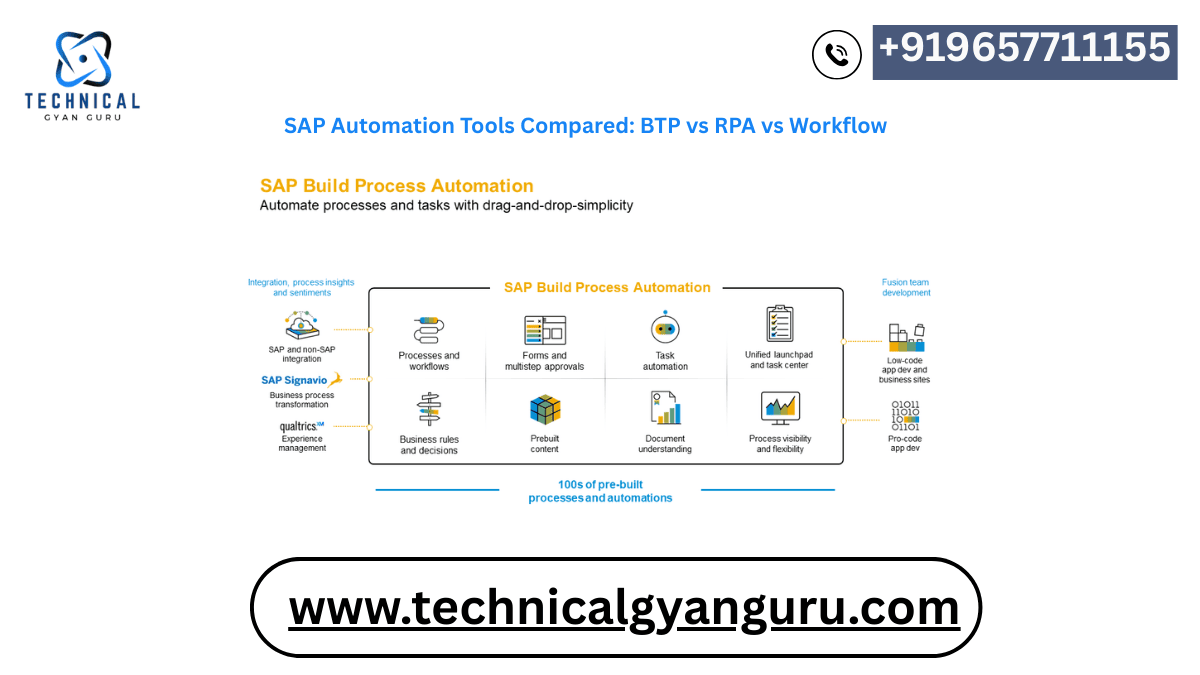
Automation has become one of the most important priorities for companies in 2025 and beyond. As organizations scale, manual and repetitive tasks slow down productivity, increase costs, and reduce accuracy. To solve this, SAP offers a rich ecosystem of automation tools—but beginners often struggle to understand which tool does what.
In this guide, we break down SAP Automation Tools—specifically SAP BTP, SAP RPA, and SAP Workflow—and compare their use cases, strengths, and real-world applications. Whether you’re a beginner or a company employee exploring automation possibilities, this guide will help you make the right decision for your business.
And yes—our focus keyword for this blog is: SAP Automation Tools.
Let’s begin by understanding why automation is so important in the modern SAP landscape.
Why SAP Automation Tools Are Becoming Essential
Companies today aim for zero-touch operations, predictive workflows, and faster digital transformation. SAP Automation Tools make these goals achievable through:
- Faster business processes
- Reduced human effort
- Lower operational costs
- Higher accuracy and compliance
- Real-time workflow monitoring
Whether you are working in logistics, finance, HR, procurement, supply chain, or customer service, SAP Automation Tools can significantly improve efficiency.
But not all tools are the same—and choosing the wrong tool can lead to delays, rework, and high implementation costs.
That’s why we need to compare SAP BTP, SAP RPA, and SAP Workflow clearly.
Understanding the Three SAP Automation Tools
To make the comparison easier, let’s define each tool in simple beginner-friendly language.
What is SAP BTP (Business Technology Platform)?
SAP BTP is the central platform where you build, extend, and integrate applications. It combines:
- Application development
- Automation services
- Integration
- AI and machine learning
- Data management
In short, SAP BTP is the foundation of modern SAP automation.
You can use it to build custom apps, extend SAP S/4HANA features, automate end-to-end business processes, and even integrate third-party tools.
When to Use SAP BTP:
- Building custom applications
- Complex automation across multiple systems
- Large-scale workflows
- Cloud-based process integration
- Using AI to enhance automation
What is SAP RPA (Robotic Process Automation)?
SAP RPA is designed to automate repetitive, rule-based tasks that humans perform manually, such as:
- Copying data between systems
- Downloading & uploading documents
- Processing emails
- Updating master data
RPA bots act like a digital workforce—running scripts and mimicking human clicks, entries, and navigation.
When to Use SAP RPA:
- Repetitive tasks
- Manual data entry
- Tasks without deep business logic
- Short-term or quick automation wins
What is SAP Workflow Management?
SAP Workflow enables organizations to create step-by-step, human + system approval processes. Think of it as a digital flow of tasks assigned to different users based on rules.
Example workflows:
- Purchase requisition approval
- Leave request automation
- Vendor onboarding
- Sales order release strategy
Workflows bring structure, transparency, and auditability into business processes.
When to Use SAP Workflow:
- Approval chains
- Multi-step tasks
- Human decision making
- Policy-driven processes
SAP Automation Tools: A Clear Comparison (BTP vs RPA vs Workflow)
Understanding each tool alone is helpful—but comparing them together is even better.
Below is a clear differentiation to help you choose the right automation tool:
Level of Automation
- SAP RPA: Robot-driven automation for repetitive tasks
- SAP Workflow: Semi-automated processes with human approvals
- SAP BTP: Full automation + custom logic + integration
Complexity
- Low: SAP RPA
- Medium: SAP Workflow
- High: SAP BTP
Best For
- SAP RPA: Quick wins and manual task reduction
- SAP Workflow: Business approvals and structured processes
- SAP BTP: Enterprise-level automation and innovation
Integration
- SAP RPA: UI based or connector based
- SAP Workflow: SAP-native integrations
- SAP BTP: Advanced multi-system integrations
AI Capabilities
- SAP RPA: Limited
- SAP Workflow: Rule-based logic only
- SAP BTP: Strong AI/ML automation
This comparison makes one thing clear: no single tool replaces the others. They each have a unique role in your digital transformation journey.
Real-World Use Cases of SAP Automation Tools
Let’s explore practical examples that beginners and professionals can easily relate to:
SAP RPA Use Cases (Simple & Repetitive)
- Auto-reading supplier emails and creating purchase orders
- Extracting invoice details from PDFs
- Uploading price lists to SAP
- Syncing data between SAP and Excel
- Automating employee onboarding documents
These tasks require little human judgment but are time-consuming—perfect for RPA.
SAP Workflow Use Cases (Human Approvals)
- PR → PO approval
- HR leave request approval
- Supplier master approval
- Budget release approvals
- Quality inspection approvals
These workflows involve rules, steps, and assigned responsibilities.
SAP BTP Use Cases (Enterprise Automation)
- Building a custom app to automate inventory shortages
- Integrating SAP with third-party CRM
- Predicting delays using AI and auto-triggering workflow
- Global procurement automation
- Full supply-chain automation
BTP is used where complex logic, cloud integration, and scalability matter.
How to Choose the Right SAP Automation Tool
Choosing the right tool depends on 5 key factors:
1. Type of process
- Repetitive? → SAP RPA
- Structured approval? → SAP Workflow
- Complex automation? → SAP BTP
2. Execution speed
RPA is fastest for short-term goals, BTP is ideal for long-term scalability.
3. Integration needs
If multiple SAP and non-SAP apps are involved—go with SAP BTP.
4. Human involvement
Workflows are perfect when employees must approve or review tasks.
5. Future expansion
If the process may grow, choose BTP from the start.
Industry Trends in SAP Automation for 2025–2027
Automation in SAP is evolving quickly, and here are the top future trends:
- AI-driven bots replacing basic RPA
- Hyperautomation combining BTP + Workflow + RPA
- Process mining to identify automation opportunities
- Predictive workflow approvals
- End-to-end business automation using SAP Build Process Automation
- No-code / low-code development becoming standard
Companies investing early in automation tools will gain a major competitive advantage by 2027.
Conclusion: Which SAP Automation Tool Should You Choose?
To summarize:
- Use SAP RPA when tasks are manual and repetitive
- Use SAP Workflow when business approvals are required
- Use SAP BTP when you need intelligent, scalable, future-ready automation
All three are powerful—but together, they form a complete automation ecosystem.
If you want to learn more about SAP automation, explore our in-depth guides, real-world case studies, and practical course recommendations.
Call to Action (CTA)
Ready to master SAP Automation Tools and boost your career?
Explore our advanced tutorials, SAP BTP courses, and real-world workflow automation guides to start your automation journey today.
The Future of Media Consumption: What Tech Buyers Expect in 2024 and Beyond…
Building Interactive Forms with Adobe LiveCycle Designer
oracle dba architecture interview questions