
 Varad
Varad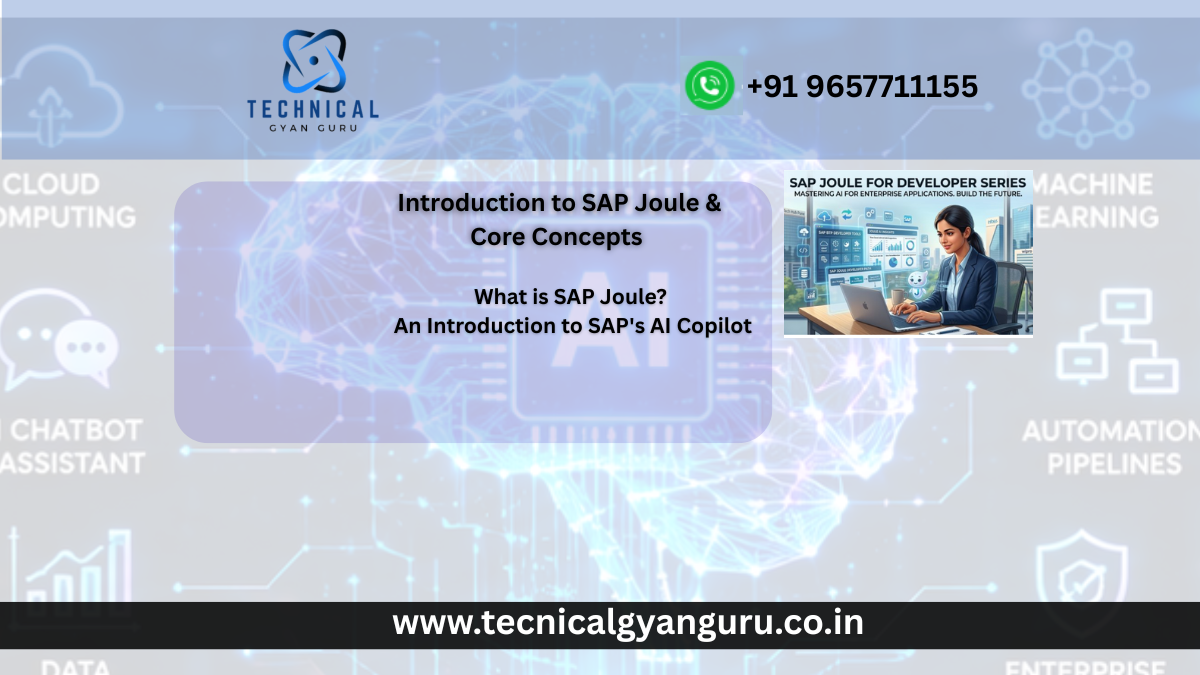
Enterprise software has never been accused of being simple. Anyone who has spent time navigating SAP systems knows that even experienced professionals can spend a significant portion of their day hunting through menus, running manual reports, and cross-referencing data across modules before arriving at a decision. SAP Joule is the company’s direct answer to that problem. Announced in 2023 and rolling out rapidly across SAP’s product portfolio through 2024 and 2025, Joule is a generative AI copilot built natively into the SAP ecosystem. It is designed to reduce friction, surface insights faster, and fundamentally change how people interact with enterprise software. If you have been hearing the name but are not entirely sure what it means for your organization, this introduction will walk you through everything you need to know.
What Exactly Is SAP Joule?
SAP Joule is a generative AI assistant embedded directly into SAP’s business applications. Rather than living as a separate tool that users must switch between, Joule appears as a conversational interface within the products you are already using, including SAP S/4HANA Cloud, SAP SuccessFactors, SAP Ariba, SAP Customer Experience, and SAP Business Technology Platform. The name is a nod to the unit of energy in physics, and the metaphor is intentional. SAP positions Joule as the energy that drives smarter, faster work across the enterprise.
At its core, Joule is a large language model-powered copilot trained on SAP-specific data and business context. This distinction matters enormously. Generic AI assistants can answer general questions and help with writing, but they have no understanding of what a purchase order approval workflow looks like, how a cost center hierarchy functions, or what a variance report in CO-PA should tell a finance manager. Joule is trained to understand SAP terminology, business processes, and data structures, which means its responses are grounded in the context of what enterprise users actually do every day.
How SAP Joule Works Inside the SAP Ecosystem
When a user opens SAP Joule within an SAP application, they are presented with a natural language chat interface. Instead of navigating to a specific transaction or building a query manually, the user simply types or speaks their question in plain language. Joule interprets the intent, pulls data from the connected SAP system, and returns a response that may include text, data visualizations, recommended actions, or a combination of all three.
For example, a finance manager working in SAP S/4HANA Cloud might ask Joule to show overdue vendor invoices above a certain threshold, explain why a specific cost center is over budget, or draft a summary of the current month’s financial position. Joule does not just return a list of transactions. It understands the context of the question, applies business logic, and presents information in a way that supports decision making rather than simply dumping raw data onto the screen.
The Role of SAP Business Technology Platform
Joule is built on SAP Business Technology Platform, which serves as the underlying infrastructure for the entire initiative. BTP provides the data connectivity, security controls, and model governance that allow Joule to function across different SAP applications without requiring each system to be rebuilt from scratch. The AI Foundation layer within BTP is what enables Joule to connect to multiple data sources, retrieve relevant records in real time, and present consolidated insights even when that data spans several different SAP modules or cloud environments.
This architecture also means that organizations building custom applications on BTP can embed Joule capabilities into their own extensions. Developers working with SAP Build or the SAP AI Core service can leverage the same Joule framework to create domain-specific AI assistants tailored to their organization’s unique processes and terminology.
Natural Language Processing Meets Business Context
One of the more technically impressive aspects of Joule is the way it combines large language model capabilities with what SAP calls business context grounding. When Joule receives a question, it does not just search for a keyword match in a database. It evaluates the user’s role, the application they are working in, the data they have permission to access, and the business process most likely associated with their query. This multi-layered context evaluation is what separates a genuinely useful enterprise AI copilot from a generic chatbot that happens to be embedded in business software.
SAP has also invested heavily in ensuring that Joule’s responses are role-aware. A procurement analyst asking about supplier performance will receive a different type of response than a supply chain manager asking the same question, because the data that matters most and the actions that are most relevant differ significantly between those roles. This role-based intelligence is one of the features that makes Joule feel like a genuine colleague who understands your job rather than an automated system that treats everyone identically.
Where SAP Joule Is Available Today
SAP has been embedding Joule across its product portfolio at a pace that has accelerated considerably since the initial launch. In SAP SuccessFactors, Joule helps HR professionals generate job descriptions, summarize employee profiles, recommend learning content, and analyze workforce data. In SAP Ariba, procurement teams can use Joule to analyze spend categories, identify supplier risk, and get recommendations on sourcing strategy. In SAP Sales Cloud, account managers can ask Joule to summarize customer interactions, flag deals at risk, and suggest next best actions based on pipeline data.
Within SAP S/4HANA Cloud, which remains the backbone of many organizations’ ERP landscapes, Joule integrates with financial accounting, procurement, order management, and manufacturing processes. Finance teams can use it to accelerate period-end close by asking for exception reports, identifying postings that need review, and generating preliminary commentary for management reporting packages. Operations teams can track production orders, monitor quality notifications, and get early warning signals on supply disruptions, all through a conversational interface that does not require deep SAP transaction knowledge.
SAP Joule for Developers and IT Teams
The developer story for Joule is equally compelling. SAP has made Joule available within SAP Build, the company’s low-code development environment, where it acts as a coding assistant and process design companion. Developers can describe what they want to build in natural language and Joule will generate initial code, suggest application structures, and help troubleshoot logic errors. For organizations with SAP Business Application Studio, Joule is available as an AI pair programmer that understands ABAP, CAP, and SAPUI5, reducing the time developers spend writing boilerplate code and searching documentation.
IT administrators using SAP Cloud ALM benefit from Joule’s ability to analyze system health data, surface configuration recommendations, and help interpret alerts in plain language. This is particularly valuable for teams managing complex SAP landscapes where an alert in one area of the system can have downstream effects that are difficult to trace manually.
The Business Case for SAP Joule
Understanding what SAP Joule is technically is one thing. Understanding why it matters for your organization requires thinking about the problem it solves at scale. Enterprise software is complex, and that complexity has real costs. Training new employees to use SAP systems takes months. Experienced users still spend significant time on tasks that require process knowledge rather than analytical judgment. Reports that should inform decisions often arrive too late or require manual interpretation before they are useful.
Joule addresses each of these friction points. New employees can ask questions in plain language and receive guided assistance without needing to memorize transaction codes or navigate unfamiliar menu structures. Experienced users can delegate repetitive information retrieval tasks to Joule and focus their attention on analysis and decision making. Management reporting cycles can compress when the AI can assemble preliminary data and flag anomalies that need human review.
Real-World Impact Across Industries
SAP has published case studies and early adoption results from organizations across manufacturing, retail, financial services, and the public sector. In manufacturing environments, Joule has reduced the time plant managers spend pulling production reports by surfacing key metrics directly in response to natural language questions. In retail, merchandising teams have used Joule to analyze inventory performance and receive reorder recommendations without exporting data to spreadsheets for manual analysis. In financial services, compliance teams have used Joule to review regulatory reporting data and identify exceptions that would previously have required dedicated analyst time to surface.
These are not marginal improvements. When you multiply even a few minutes of saved time per user across hundreds or thousands of SAP users in a large organization, the aggregate productivity gain becomes significant very quickly. The more meaningful long-term impact, however, comes from the quality of decisions. When insights are surfaced faster and presented in a more accessible format, the people making decisions have more time to evaluate options and apply judgment, which tends to produce better outcomes than decisions made under time pressure with incomplete information.
What Makes SAP Joule Different from Other AI Assistants
The enterprise AI market has become crowded very quickly. Microsoft Copilot, Google Gemini for Workspace, and a growing number of standalone AI tools all claim to improve productivity. So what makes SAP Joule distinct from these alternatives? The answer comes down to depth of integration and business context specificity.
A general-purpose AI assistant embedded in productivity software can help you draft an email or summarize a document. It does not know what a GR/IR clearing account is, why a dunning block might need to be removed before a payment run, or how to interpret a cost element report in the context of a budget variance conversation. Joule does, because it has been specifically trained on SAP business processes and integrated directly with live SAP data rather than relying on static document retrieval.
This specificity also extends to compliance and security. SAP Joule operates within the same data access controls that govern the rest of the SAP system. If a user does not have authorization to see payroll data, Joule will not surface payroll information in response to their queries, even if that data technically exists in the system. This role-based data governance is built into the architecture rather than bolted on as an afterthought, which is essential for organizations operating under strict data privacy regulations.
Getting Started with SAP Joule in Your Organization
If your organization is already running SAP S/4HANA Cloud or any of the other SAP cloud applications where Joule is available, the first step is to confirm with your SAP account team which Joule features are included in your current licensing and which require additional entitlement. SAP has been bundling Joule capabilities into cloud subscriptions progressively, so the answer may be more favorable than you expect.
Once access is confirmed, the practical rollout involves enabling Joule in the relevant applications, configuring the data connections within BTP, and defining the user roles that should have access to specific Joule capabilities. SAP provides implementation guides and partner-supported rollout accelerators that significantly reduce the time and technical complexity involved in getting Joule operational.
From a change management perspective, the most effective adoption programs focus on identifying high-impact use cases first rather than trying to introduce Joule across all processes simultaneously. Finance teams running month-end close, procurement teams managing supplier performance reviews, and HR teams handling high-volume talent processes tend to see the fastest and most measurable return. Starting with these groups, measuring the impact, and then expanding based on demonstrated value is a proven approach that builds organizational confidence in the technology before scaling it more broadly.
The Future of SAP Joule
SAP has been explicit about its intention to make Joule the primary user interface for the SAP system over time. Rather than thinking of Joule as a feature added to existing applications, SAP’s vision is that Joule becomes the way most users interact with SAP most of the time. Transactions and traditional menu-based navigation will remain available, but the expectation is that conversational AI will handle a growing share of routine interactions, freeing the traditional interface for complex configuration and edge-case scenarios.
The roadmap includes deeper agentic capabilities, where Joule will not just answer questions but autonomously execute multi-step business processes based on a user’s instruction. Early examples of this agentic behavior are already visible in some SAP applications, where Joule can initiate a procurement process, route it for approval, and confirm completion without the user needing to navigate each step manually. As these capabilities mature and the trust in AI-assisted execution grows, the nature of what it means to work with SAP systems will shift fundamentally.
For organizations making long-term technology decisions today, understanding SAP Joule is not optional. It represents the direction that SAP’s entire product strategy is moving, and the organizations that engage with it thoughtfully now will be better positioned to capture its value as the capabilities continue to expand. Whether you are an IT leader evaluating your SAP roadmap, a finance or HR professional looking to work more efficiently, or a developer building on BTP, SAP Joule deserves a prominent place in your planning conversations for 2025 and beyond.