
 Varad
Varad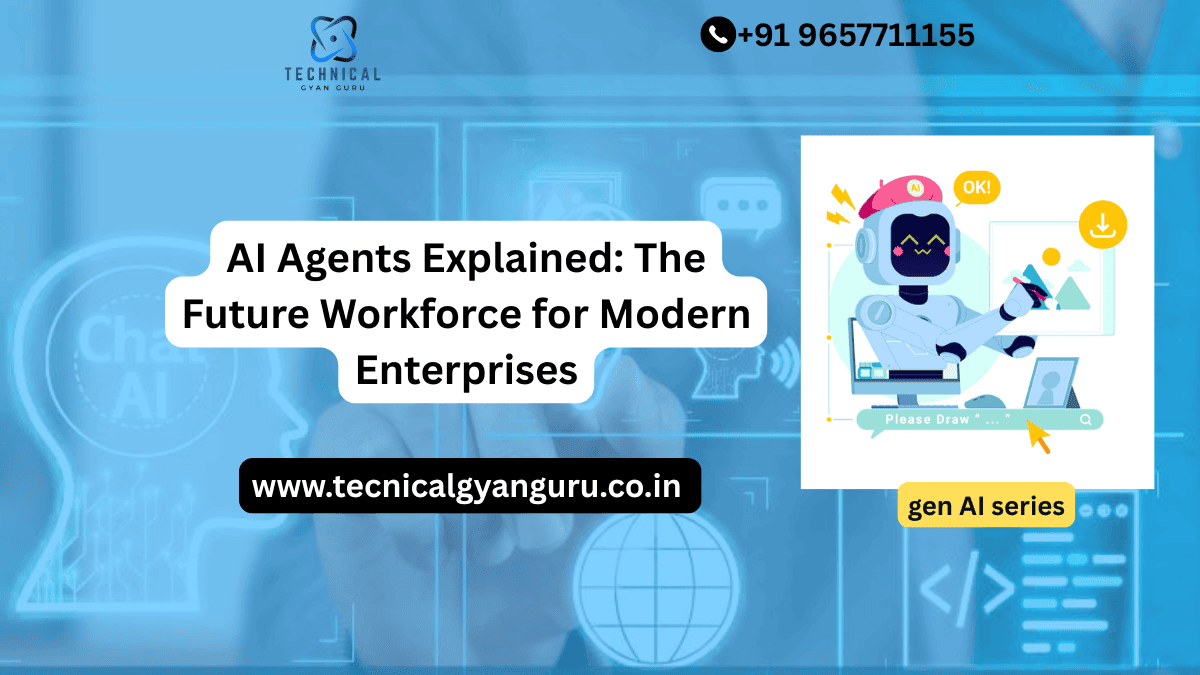
Every enterprise leader is asking the same question in 2026. How do we get more done without simply hiring more people. The answer that keeps surfacing in boardrooms, tech roadmaps, and industry conferences is AI agents. Unlike simple chatbots or rule based automation, AI agents can plan, reason, take action across multiple systems, and complete multi step tasks with minimal human input. They are quickly becoming what many analysts now call the future workforce, a digital layer of employees that work alongside human teams to handle repetitive, data heavy, or time sensitive work.
This article breaks down what AI agents actually are, why enterprises are rushing to adopt them, where they deliver the most value, and how your organization can start building a practical AI agent strategy without falling into common traps.
What Are AI Agents
An AI agent is a software system built on large language models that can understand a goal, break it into steps, use tools or APIs, and complete a task with limited or no human supervision. Think of it as the difference between a calculator and an employee. A calculator only responds to exact input. An employee understands context, makes decisions, checks their work, and adapts when something unexpected happens.
Modern AI agents can read emails and respond appropriately, pull data from a CRM, update a spreadsheet, schedule meetings, generate reports, flag anomalies in financial data, or even negotiate simple vendor terms based on predefined rules. Some agents work independently on a single task, while others operate in coordinated teams, each handling a different part of a larger workflow.
Why Enterprises Are Adopting AI Agents Now
A few forces are converging at once. First, language models have become reliable enough to handle multi step reasoning without constant errors. Second, the cost of running these models has dropped significantly, making large scale deployment financially realistic. Third, businesses are under constant pressure to do more with leaner teams, especially in customer support, finance, and operations.
A retail company using AI agents for inventory forecasting can reduce stockouts by predicting demand patterns across hundreds of stores simultaneously, something a small planning team could never do manually at the same speed. A logistics company can deploy agents that monitor shipment delays in real time and automatically reroute deliveries before a human even notices the disruption. These are not hypothetical use cases. They are already running in production environments today.
Key Use Cases of AI Agents in Modern Enterprises
Customer Service and Support
AI agents are transforming support desks by handling tier one and tier two queries end to end. Instead of just answering FAQs, agents can access order history, process refunds, update account details, and escalate only the truly complex issues to human agents. Companies using this model report faster resolution times and noticeably lower support costs, while human agents get to focus on cases that actually require empathy and judgment.
Sales and Marketing Automation
Sales teams are using AI agents to qualify leads, personalize outreach at scale, and even draft follow up sequences based on a prospect’s behavior. A marketing agent might monitor campaign performance across five different platforms, then automatically shift budget toward the channels generating the best return, all without a marketer manually checking dashboards every morning.
IT Operations and DevOps
In technical departments, AI agents are being used to monitor system health, detect anomalies, and even resolve certain incidents automatically before they affect end users. A well configured agent can identify a memory leak, restart the affected service, and log the entire incident with a summary for the engineering team, cutting downtime significantly.
Finance and Back Office Automation
Finance departments are deploying agents to reconcile invoices, flag suspicious transactions, and generate monthly reports that used to take analysts days to compile. Because these agents can cross reference multiple data sources instantly, they often catch discrepancies that a human reviewer might miss during a manual check.
Human Resources and Recruitment
HR teams are using AI agents to screen resumes, schedule interviews, answer employee policy questions, and even draft personalized onboarding plans. This frees recruiters to focus on relationship building and final decision making rather than administrative busywork.
How AI Agents Differ From Traditional Automation and Chatbots
Traditional automation tools like robotic process automation follow strict, predefined rules. If a process changes even slightly, the automation breaks. Chatbots, on the other hand, are typically limited to answering questions within a fixed script or knowledge base.
AI agents are fundamentally different because they combine reasoning with action. They can interpret ambiguous instructions, decide which tool to use for a given task, adapt when the first approach fails, and learn from context within a conversation or workflow. This is why enterprises describe agents as digital coworkers rather than software features. They do not just respond, they actually get work done.
Building an AI Agent Strategy: Practical Steps
Start With a Narrow Use Case
The biggest mistake companies make is trying to deploy agents across the entire organization at once. Instead, pick one specific, well defined process, something with clear inputs, outputs, and success metrics. Handling customer refund requests or generating weekly sales summaries are great starting points because the value is measurable within weeks.
Choose the Right Framework and Tools
Depending on your technical maturity, you might build agents using established frameworks that connect large language models to internal tools and APIs. Enterprises with strong engineering teams often build custom solutions, while smaller organizations benefit from ready made platforms that offer agent building with minimal coding. The right choice depends on your existing tech stack, your data security requirements, and your team’s technical capacity.
Ensure Human Oversight
Even the most advanced agent should operate with checkpoints. For financial transactions, legal communications, or anything customer facing, build in review steps where a human confirms the agent’s decision before it goes live. This protects your business from costly mistakes while your team builds trust in the system over time.
Measure ROI Continuously
Track time saved, error rates, cost per task, and employee satisfaction before and after deployment. Many companies find that agents deliver strong returns in operational efficiency but need continuous fine tuning to stay accurate as business processes evolve. Treat this as an ongoing optimization project, not a one time setup.
Challenges and Risks to Watch
AI agents are powerful, but they are not without risk. Data privacy is a major concern, especially when agents access sensitive customer or financial information across multiple systems. Enterprises need clear governance policies defining what data agents can access and how that access is logged and audited.
Accuracy is another challenge. While models have improved dramatically, agents can still make mistakes, especially in edge cases they were not explicitly trained to handle. This is why human oversight remains essential, particularly for high stakes decisions.
There is also the question of accountability. If an agent makes an error that costs the company money or damages a customer relationship, who is responsible. Organizations need internal policies that clearly define ownership and escalation paths before agents are given real authority over business processes.
Finally, employee concerns around job displacement are real and should not be dismissed. The most successful enterprise rollouts are the ones where leadership communicates clearly that agents are meant to remove repetitive busywork, not replace entire departments, and where employees are retrained to work alongside these tools rather than compete with them.
The Future Workforce: Humans and AI Agents Working Together
The organizations seeing the best results are not the ones replacing people with agents. They are the ones redesigning workflows so humans and agents each do what they do best. Agents handle volume, speed, and repetitive analysis. Humans handle judgment, relationship building, creative problem solving, and strategic decisions.
Picture a customer support team where agents resolve 70 percent of tickets instantly, while human agents spend their entire day on complex, high value conversations that actually require emotional intelligence. Or a finance department where agents handle reconciliation and reporting, freeing analysts to focus on forecasting and strategic recommendations instead of spreadsheet maintenance.
This is the real shift happening in enterprises today. It is not about replacing the workforce. It is about expanding what a workforce can accomplish by giving every employee access to a tireless digital collaborator that handles the repetitive parts of the job.
Companies that start experimenting now, even with a single narrow use case, are positioning themselves years ahead of competitors who wait for the technology to become mainstream before taking action. The businesses that treat AI agents as a core part of their operating model, not just a side experiment, are the ones that will define efficiency standards across every industry in the coming years
.
If your organization has not yet piloted an AI agent project, now is the time to start small, measure results honestly, and scale what works. The future workforce is already here, and it is working alongside the best enterprises in the world right now.