
 Varad
Varad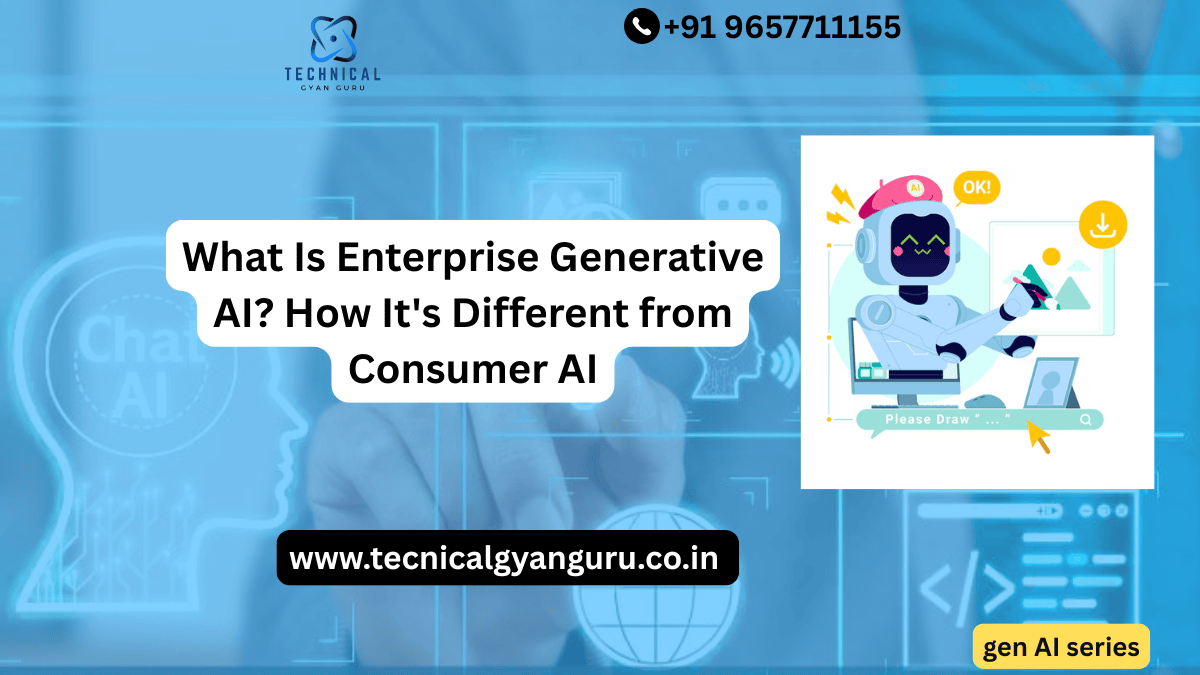
Every company claims to be “doing AI” right now, but there is a massive difference between an employee typing a question into a public chatbot and a bank using a governed AI system to process loan applications across 40 countries. That gap is exactly what enterprise generative AI is built to close. If you have ever wondered why your company’s IT department will not just let everyone use the free version of a popular chatbot for sensitive work, this article will explain the real distinction between enterprise generative AI and consumer AI, and why that distinction matters more than most people realize.
What Enterprise Generative AI Actually Means
Enterprise generative AI refers to generative AI tools and platforms built specifically for organizational use, with the security, compliance, scalability, and integration capabilities that a business needs to operate safely at scale. It is not just a rebranded chatbot with a corporate logo slapped on it. It is an entirely different category of software built around data governance, access controls, auditability, and deep integration with the systems a company already relies on, such as CRMs, ERPs, document repositories, and internal knowledge bases.
Think of it this way. Consumer AI is like a public library where anyone can walk in, ask questions, and read the answer off a shared shelf. Enterprise AI is more like a private research department inside a company, where the sources are vetted, the notes are locked in a secure filing cabinet, and every request is logged so someone can trace exactly who asked what and why.
The Core Differences Between Enterprise and Consumer AI
Data Privacy and Ownership
This is the single biggest difference and the one that keeps most CIOs up at night. When you use a free consumer AI tool, your prompts and the data you paste into it may be stored, reviewed, or even used to train future versions of the model, depending on the provider’s policy and your account settings. For a business handling customer records, financial data, or proprietary source code, that is an unacceptable risk.
Enterprise generative AI platforms typically offer contractual guarantees that customer data will not be used for model training, along with data residency options so companies can control which geographic region their data lives in. Many also offer private or dedicated model instances so a company’s data never mixes with anyone else’s.
Security and Compliance Controls
Enterprise tools are built to satisfy frameworks like SOC 2, ISO 27001, HIPAA, and GDPR, which consumer tools generally are not designed around. This means enterprise AI platforms come with features like single sign on, role based access control, encryption at rest and in transit, and detailed audit logs that show exactly which employee accessed which data and when.
A hospital system using AI to summarize patient records needs HIPAA level protection. A law firm using AI to review contracts needs attorney client privilege protections baked into the workflow. Consumer tools simply were not built with these regulatory realities in mind, and using them for such work can expose a company to serious legal liability.
Integration With Business Systems
Consumer AI usually lives in isolation. You open a chat window, type a question, get an answer, and that is the end of the interaction. Enterprise generative AI is designed to plug directly into the tools employees already use every day, such as Salesforce, SAP, Slack, Microsoft 365, Google Workspace, and internal databases.
This is where the real productivity gains show up. Instead of copying and pasting data between systems, an enterprise AI assistant can pull live inventory numbers from a warehouse management system, cross reference them with sales forecasts in a spreadsheet, and draft a purchasing recommendation, all without an employee touching more than one interface.
Customization and Fine-Tuning
Consumer AI gives everyone the same generic model with the same generic personality and knowledge base. Enterprise AI allows organizations to fine tune models on their own proprietary data, terminology, and workflows. A pharmaceutical company can train a model to understand its internal research vocabulary. A retail chain can customize a model to know its exact product catalog and return policies down to the last detail.
This customization is often achieved through techniques like retrieval augmented generation, where the AI pulls from a company’s internal document library in real time rather than relying purely on what it learned during training. The result is answers that are grounded in a company’s actual reality instead of generic internet knowledge.
Governance and Accountability
In a consumer setting, if the AI gives a wrong or biased answer, the consequences are usually limited to one person’s confusion or frustration. In an enterprise setting, a bad AI output can mean a wrong financial report going to shareholders, a discriminatory hiring recommendation, or a compliance violation that triggers regulatory fines.
Because of this, enterprise generative AI platforms include governance layers that consumer tools skip entirely. These include content filtering tuned to company policy, human in the loop review for high stakes decisions, model performance monitoring, and clear accountability chains showing who approved which AI generated output before it went live.
Scalability and Reliability
A consumer chatbot might occasionally go down or slow to a crawl during peak usage, and for an individual user that is a minor annoyance. For a business running thousands of AI powered customer service interactions per hour, downtime translates directly into lost revenue and damaged customer trust.
Enterprise AI providers offer service level agreements that guarantee uptime, dedicated infrastructure that does not get overwhelmed by public demand spikes, and support teams that a business can actually call when something breaks. This reliability is not a luxury feature. It is a baseline requirement for any company that wants to build critical workflows around AI.
Real-World Examples of Enterprise Generative AI in Action
A global insurance company might deploy an enterprise AI system to review thousands of claims documents daily, flagging inconsistencies for human adjusters while maintaining a complete audit trail for regulators. A manufacturing firm might use enterprise AI to generate maintenance reports by pulling sensor data directly from factory equipment and cross referencing it against historical failure patterns. A large law firm might use it to draft first pass contract reviews, with every AI suggestion tagged and traceable back to the specific clause and precedent that informed it.
Compare that to a freelance graphic designer using a consumer AI tool to brainstorm slogans for a client pitch. Both are legitimate uses of generative AI, but the stakes, the data sensitivity, and the required infrastructure are worlds apart.
Why Businesses Cannot Just Use Consumer AI Tools
Some smaller businesses try to save money by having employees use free or personal AI accounts for work tasks. This creates what is sometimes called shadow AI, where sensitive company information ends up scattered across dozens of unmanaged personal accounts with no oversight, no audit trail, and no way to guarantee that data has not been exposed or misused.
Beyond the security risk, there is a consistency problem. If ten employees are all using different personal AI accounts with different settings and different prompt habits, the quality and accuracy of the output will vary wildly. Enterprise deployments solve this by standardizing prompts, connecting the AI to verified internal data sources, and monitoring output quality across the entire organization.
How to Choose the Right Enterprise AI Approach
Companies exploring enterprise generative AI generally have three paths available. The first is subscribing to an enterprise tier of an existing AI platform, which offers the fastest path to deployment with built in security and support. The second is building custom AI applications on top of a foundation model’s API, which offers maximum flexibility for companies with unique workflows and dedicated technical teams. The third is a hybrid approach, using enterprise platform subscriptions for general productivity while building custom integrations for the specific processes that need deeper automation.
Before choosing a path, it helps to ask a few practical questions. What kind of data will the AI actually touch, and what regulations apply to that data. Which existing systems does the AI need to connect with to be genuinely useful rather than just another disconnected tool. Who inside the company will be accountable for reviewing AI generated outputs before they reach customers or regulators. Answering these questions honestly usually points a company toward the right starting point far more effectively than chasing whichever tool is trending that month.
The Bottom Line
Enterprise generative AI and consumer AI may share the same underlying technology, but they exist to solve very different problems. Consumer AI is built for speed, accessibility, and individual convenience. Enterprise generative AI is built for security, accountability, and integration at organizational scale. As more companies move from experimenting with AI to actually running critical operations through it, understanding this distinction is not just a technical detail. It is the difference between a tool that helps one person get through their day and a system that an entire organization can trust with its most sensitive work.