
 Varad
Varad
The way businesses operate is going through one of its biggest shifts in decades, and most of it is happening quietly in the background of everyday operations. A few years ago, the word automation mostly meant simple chatbots answering basic customer questions on a website. Today, that same word describes something far more powerful. AI agents are now capable of making decisions, completing multi step tasks, and working across different systems without constant human supervision. This shift from chatbots to AI agents is not just a technical upgrade. It represents a fundamental change in how companies think about productivity, customer experience, and scale.
If you run a business, manage a team, or work in operations, understanding this evolution is no longer optional. The companies that adapt early are already seeing measurable gains in efficiency, while those relying on outdated automation tools are starting to fall behind. This article breaks down how we got here, what makes AI agents different from traditional chatbots, and how businesses can practically use this technology today.
The Early Days of Chatbots
Chatbots first became popular because they solved one specific problem. Customers wanted fast answers, and businesses could not afford to have a human available every hour of the day. Early chatbots were built on simple rule based systems. They followed a strict decision tree. If a customer typed a certain keyword, the bot returned a pre written response. If the input did not match any rule, the bot either repeated itself or redirected the customer to a human agent.
These systems were useful for basic tasks like answering frequently asked questions, tracking orders, or resetting passwords. However, they had serious limitations. They could not understand context, they struggled with anything outside their scripted flow, and they often frustrated customers more than they helped them. Anyone who has typed a slightly unusual question into an old customer service bot and received a completely unrelated answer knows this experience well.
Why Traditional Chatbots Hit a Ceiling
The biggest issue with rule based chatbots was rigidity. Businesses had to manually map out every possible conversation path, which became unmanageable as customer needs grew more complex. Updating these systems required developers to rewrite logic trees, which slowed down innovation. Chatbots also lacked memory. Each conversation started from zero, so they could not build on previous interactions or personalize responses based on user history.
This created a ceiling. Businesses could automate simple, repetitive tasks, but anything requiring judgment, reasoning, or multi step problem solving still needed a human. That limitation is exactly what the next generation of automation was built to solve.
The Rise of AI Agents
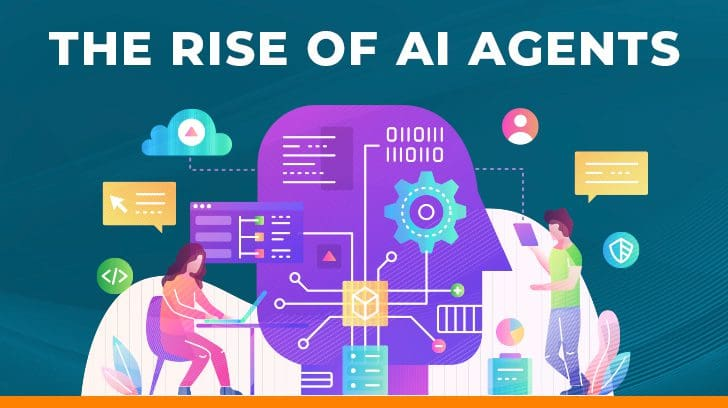
AI agents represent a completely different approach to automation. Instead of following rigid scripts, they use large language models combined with reasoning capabilities to understand goals, break them into steps, and execute those steps using tools, APIs, and integrations. In simple terms, an AI agent does not just respond. It acts.
For example, a traditional chatbot might tell a customer their order is delayed. An AI agent can check the order status across multiple systems, identify the cause of the delay, offer a solution such as a discount or expedited shipping, and then update the customer record automatically. All of this can happen without a human stepping in, and the agent can explain its reasoning if needed.
This shift matters because businesses run on processes, not just conversations. AI agents can plug into those processes directly, whether that means updating a CRM, generating a report, scheduling a meeting, or coordinating between departments.
Key Capabilities That Set Agents Apart
There are a few core capabilities that separate AI agents from earlier automation tools. The first is reasoning. Agents can evaluate information, weigh options, and choose an appropriate action rather than matching a fixed input to a fixed output. The second is tool use. Modern AI agents can call external tools such as databases, calendars, payment systems, or internal software to complete tasks in the real world rather than just providing information about them.
The third capability is memory. Agents can retain context across a conversation or even across multiple sessions, allowing for more personalized and consistent interactions over time. The fourth is autonomy. While a chatbot waits for input and gives a single response, an agent can complete a sequence of actions on its own, checking its own work along the way and adjusting if something does not go as planned.
Real World Examples of AI Agents in Business
To understand why this shift matters, it helps to look at how companies are already using AI agents across different departments.
Customer Support
Instead of simply answering questions, support agents powered by AI can resolve entire tickets. If a customer reports a billing issue, the agent can pull account details, check payment history, identify the discrepancy, issue a refund if policy allows it, and send a confirmation email, all within a single interaction. Human agents only step in for edge cases that require judgment calls outside company policy.
Sales and Lead Qualification
Sales teams are using AI agents to qualify leads automatically. An agent can review a new lead’s company information, cross reference it with ideal customer profiles, schedule a call if the lead fits, and even draft a personalized outreach email based on the prospect’s industry and pain points. This used to take a sales development representative twenty to thirty minutes per lead. Agents can do it in seconds.
Internal Operations
Beyond customer facing tasks, AI agents are being used internally to manage workflows. For instance, an agent can monitor inventory levels, automatically place restock orders when supply drops below a threshold, and notify the relevant team if there is a delay from a supplier. This kind of proactive, autonomous action was simply not possible with earlier automation tools.
HR and Recruitment
In hiring, agents can screen resumes, schedule interviews based on candidate and interviewer availability, send follow up communications, and even draft initial offer letters based on approved templates and salary bands. This significantly reduces the administrative burden on HR teams, freeing them to focus on relationship building and culture rather than paperwork.
Why This Shift Matters for Businesses Right Now
The move from chatbots to AI agents is not just a technology trend, it is a competitive necessity. Companies that adopt agentic automation are able to operate with smaller teams handling larger volumes of work, respond to customers faster, and reduce the number of errors that come from manual, repetitive tasks.
There is also a cost factor. Hiring and training staff for repetitive operational tasks is expensive and time consuming. AI agents can handle a significant portion of that workload, allowing human employees to focus on strategy, relationship building, and creative problem solving, the areas where people genuinely add the most value.
Customer expectations have also changed. People are used to fast, personalized service, and they notice when a business is slow or inconsistent. AI agents help close that gap by providing accurate, immediate responses around the clock, without the fatigue or inconsistency that can come with human only support during high volume periods.
How Businesses Can Start Implementing AI Agents
Adopting this technology does not require an enormous overhaul on day one. Most successful implementations start small and expand gradually.
Start With a Single, Well Defined Process
Choose one repetitive process that already has clear rules, such as order status updates, appointment scheduling, or basic customer inquiries. Automating a well understood process first makes it easier to measure results and build internal confidence in the technology.
Integrate With Existing Systems
AI agents are most powerful when they can connect to the tools a business already uses, such as CRMs, help desk software, inventory systems, or calendars. Before choosing a platform, businesses should confirm that it supports integration with their existing tech stack.
Set Clear Boundaries and Escalation Rules
Even the most advanced AI agent should know when to hand a task off to a human. Defining clear escalation rules, such as flagging high value transactions or unusual requests, helps maintain trust while still allowing the agent to handle the majority of routine work.
Monitor and Refine Continuously
AI agents improve with feedback. Businesses should review agent performance regularly, look for patterns in escalated cases, and adjust instructions or workflows based on what is and is not working well. This is an ongoing process, not a one time setup.
Common Concerns About AI Agents
Many business owners hesitate to adopt AI agents because of concerns around accuracy, security, or losing the human touch in customer interactions. These are valid considerations. The key is designing systems with the right guardrails. This means setting clear permissions for what an agent can and cannot do, logging every action for transparency, and keeping a human review process in place for sensitive decisions such as refunds above a certain amount or actions that affect customer accounts significantly.
It is also worth noting that AI agents are meant to handle volume and repetition, not replace the human relationships that build long term customer loyalty. The businesses seeing the best results are the ones that use agents to remove friction and free up time, while still keeping people at the center of important decisions and relationships.
What Comes Next in Business Automation
The evolution from chatbots to AI agents is still in its early stages, and the pace of change is not slowing down. Future systems will likely coordinate multiple specialized agents working together, similar to how a human team divides responsibilities. One agent might handle customer communication while another manages logistics, with both sharing information seamlessly to complete a larger task.
Businesses that build a strong foundation now, by cleaning up their data, defining clear processes, and experimenting with agent based tools in low risk areas, will be far better positioned to take advantage of these advancements as they arrive. The gap between businesses using basic automation and those using intelligent agents is only going to widen over the next few years.
Final Thoughts
The shift from chatbots to AI agents marks a turning point in how businesses handle everyday work. What started as simple scripted responses has evolved into systems capable of reasoning, acting, and completing entire workflows with minimal human input. For businesses willing to adopt this technology thoughtfully, the payoff includes faster operations, lower costs, and happier customers. The companies that treat this shift seriously today are the ones that will lead their industries tomorrow.