
 Varad
Varad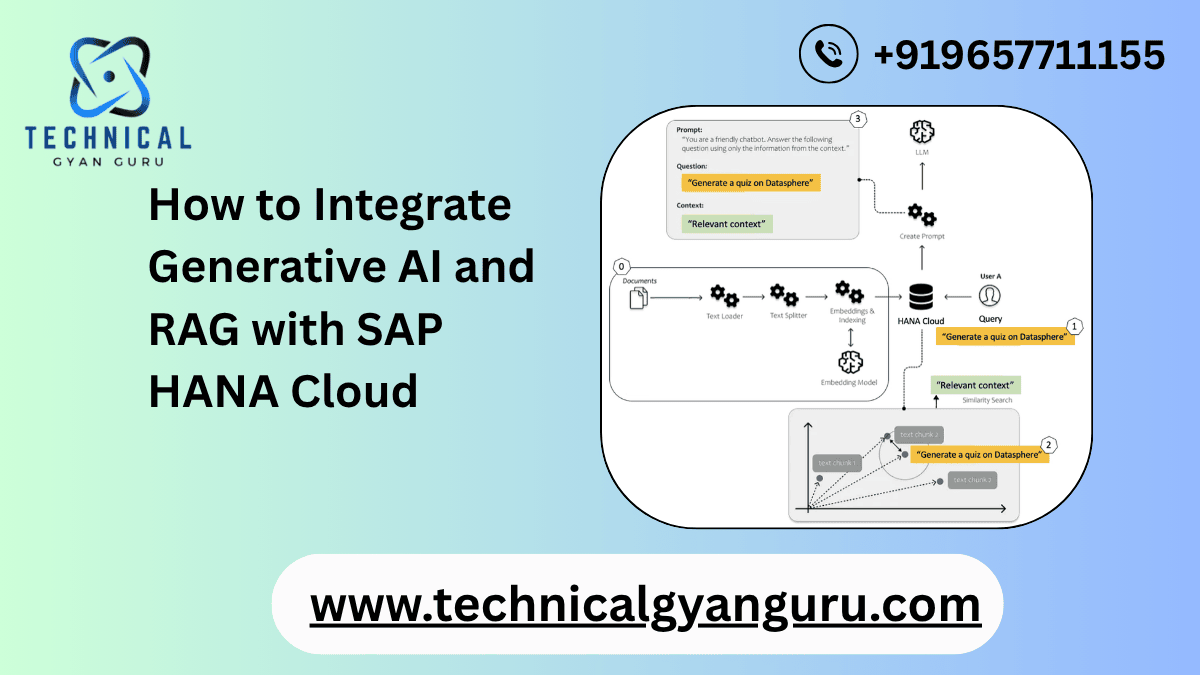
Artificial Intelligence has moved from being a futuristic buzzword to a practical tool reshaping how businesses operate today. Among the most powerful innovations in AI is the combination of Generative AI and Retrieval-Augmented Generation (RAG). While generative models can create content and answer questions, their true potential is unlocked when paired with structured enterprise data.
Understanding Generative AI and RAG
Before diving into integration, let’s break down these concepts:
- Generative AI: Refers to AI systems capable of producing human-like responses, content, or predictions based on training data. Tools like ChatGPT and image generators fall under this category.
- RAG (Retrieval-Augmented Generation): Enhances generative AI by grounding its responses in external, real-time, and domain-specific data. Instead of only relying on what the model “remembers,” RAG retrieves information from trusted sources—like SAP HANA Cloud databases—before generating an answer.
Together, these technologies balance creativity with accuracy, ensuring enterprise applications provide not just fluent but factually correct insights.
Why SAP HANA Cloud Is the Ideal Platform
Businesses generate massive amounts of data daily—sales records, supply chain details, customer interactions, and more. Without organization, this data becomes overwhelming.
SAP HANA Cloud offers:
- Scalability: Handle structured and unstructured data efficiently.
- Security: Enterprise-grade compliance ensures sensitive information remains safe.
- Integration Flexibility: Built to connect with modern AI frameworks.
- Real-time Access: Crucial for RAG systems to pull updated insights.
When combined with Generative AI, SAP HANA Cloud transforms into a central intelligence hub for businesses.
Step-by-Step Guide to Integration
Step 1: Prepare Enterprise Data in HANA Cloud
- Clean and structure data tables.
- Define schemas for critical business functions (finance, HR, supply chain).
- Use built-in tools for indexing and metadata tagging to support efficient retrieval.
Step 2: Connect Generative AI Models
- Select an LLM (Large Language Model) like GPT.
- Establish API connections between the AI model and HANA Cloud.
- Configure authentication and permissions to ensure secure access.
Step 3: Implement RAG Workflow
- Retriever Component: Directs the AI to pull data from HANA Cloud.
- Generator Component: Uses retrieved context to create precise answers.
- Validation: Test queries like “Show me the latest Q2 revenue trend compared to last year”. The response should combine AI fluency with HANA Cloud accuracy.
Step 4: Build Use Cases
- Customer Service: AI bots can provide instant, data-backed answers to customer queries.
- Finance Teams: Automate report generation with real-time numbers.
- Supply Chain Management: Predict disruptions and suggest actions.
Real-World Applications
- Retail: Personalized shopping recommendations grounded in purchase history.
- Healthcare: Clinical decision support powered by up-to-date medical data.
- Banking: Fraud detection and compliance reporting using contextual AI insights.
These are not just futuristic concepts—companies are already experimenting with such solutions, and early adopters will enjoy a clear competitive edge.
Practical Tips for Beginners
- Start Small: Begin with a single use case, such as automating FAQs or generating sales reports.
- Ensure Data Quality: The success of RAG relies heavily on the accuracy of the underlying data.
- Collaborate Across Teams: AI is not just an IT project—it involves business, compliance, and end-users.
- Leverage Pre-Built Integrations: SAP often provides connectors and templates to accelerate the process.
The Bigger Picture: Future of AI in SAP Ecosystem
By 2025 and beyond, enterprise AI will move toward explainability and trustworthiness. RAG-enabled systems built on SAP HANA Cloud will ensure that employees don’t just receive AI-driven suggestions but also understand the “why” behind them.
For organizations, this means:
- Improved decision-making.
- Higher efficiency through automation.
- Competitive advantage in an increasingly digital market.
Conclusion: Take the First Step
Generative AI combined with RAG and powered by SAP HANA Cloud isn’t just a technology trend—it’s the future of enterprise intelligence. As a beginner, your first step is to explore how your organization’s data can fuel smarter, AI-driven outcomes.
Don’t wait for competitors to take the lead—embrace AI innovation today.
👉 Ready to go deeper? Explore advanced learning resources, hands-on tutorials, and courses available on our website to turn these concepts into real-world skills.
you may be interested in this blog here:-
Cloud Application Development: Building Scalable and Secure Solutions