
 Varad
Varad
SAP automation testing has become a core part of modern SAP projects. As SAP landscapes grow more complex with cloud solutions, frequent releases, integrations and intelligent automation, manual testing alone can no longer protect business stability. In 2026, SAP automation testing focuses on faster feedback, reliable regression coverage, continuous testing and close alignment with business processes. This detailed guide explains the most important tools used for SAP automation testing in 2026, how they are used in real projects and how beginners and experienced professionals can select the right tools for their testing strategy.
Why SAP Automation Testing Is Critical in 2026
SAP systems are no longer updated once or twice a year. Many organizations run quarterly, monthly or even continuous releases. New business rules, workflow changes, integrations and security updates are deployed regularly.
Automation testing ensures that core business processes such as order to cash, procure to pay, record to report and hire to retire continue to work after every change. In 2026, automation testing is not only about technical correctness but also about protecting business outcomes, compliance and customer experience.
How SAP Automation Testing Has Evolved
Earlier automation approaches focused mainly on GUI based test scripts. Today, automation testing covers end to end business processes across SAP S4 systems, cloud applications, integrations, APIs and background processing.
Modern testing frameworks integrate directly with DevOps pipelines, support low code automation, provide business readable test flows and deliver advanced reporting for management and audit teams.
Categories of SAP Automation Testing Tools
Before reviewing individual tools, it is important to understand the major categories used in real SAP programs.
Major automation tool categories
User interface automation tools for end user processes
API and integration testing tools for system to system scenarios
Business process automation testing platforms for end to end coverage
Performance and load testing tools
Test management and reporting platforms
Continuous integration and execution tools
Each category plays a different role in a complete SAP automation testing strategy.
Business Process Automation Testing Tools
Business driven automation tools remain the backbone of SAP testing in 2026. These tools focus on business flows instead of technical objects.
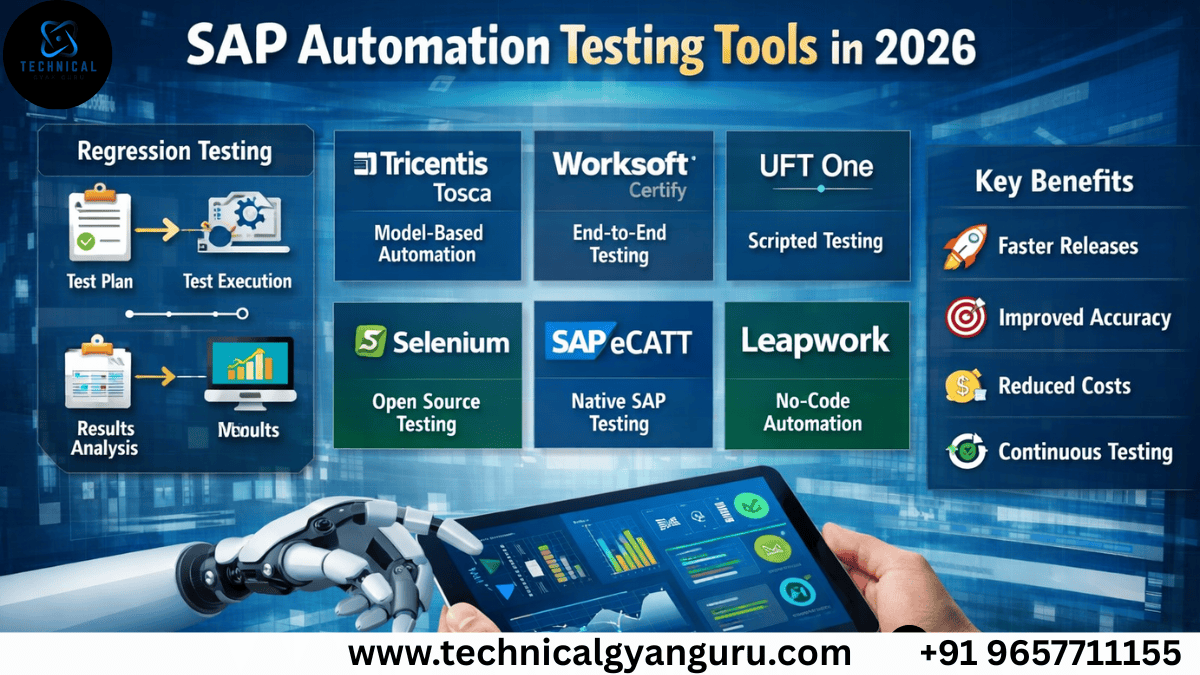
Tricentis Tosca
Tricentis Tosca is widely used for SAP automation testing because it supports model based test automation. Test cases are created using business modules instead of complex scripts.
In real projects, Tosca is used to automate end to end scenarios such as sales order processing, delivery creation, billing and financial posting.
A practical example is building a reusable sales order module and reusing it across dozens of test cases with different data combinations.
Key advantages include minimal scripting, strong SAP object recognition, robust change impact analysis and native integration with test management and reporting platforms.
Worksoft Certify
Worksoft Certify remains a popular choice for business process automation testing in large SAP environments. It focuses on business readable automation flows and supports SAP GUI, web applications and cloud applications.
In real projects, Worksoft is often used for large scale regression testing during upgrades and S4 conversions.
A typical example is automating hundreds of finance and logistics processes for quarterly release cycles without requiring technical scripting skills from business testers.
Key strengths include scalability, strong SAP integration and clear business oriented test reporting.
SAP Native Automation Testing Capabilities
SAP has expanded its native automation testing capabilities to support cloud and hybrid landscapes.
SAP Cloud based test automation and CBTA
Component based test automation is used to build reusable test components for SAP applications.
In many organizations, CBTA is used to automate core business flows for S4 and cloud solutions with tight integration into SAP solution documentation and change management.
A practical example is creating reusable components for purchase order creation, goods receipt and invoice verification and combining them to build full procure to pay regression scenarios.
Native integration with SAP tools makes it easier to align testing with business documentation and release management.
Open Source UI Automation Tools
Open source tools continue to play a strong role in SAP automation testing, especially for web based applications and hybrid landscapes.
Selenium
Selenium remains one of the most widely used UI automation tools for SAP Fiori and web applications.
Teams use Selenium to validate user journeys across SAP portals, cloud platforms and integrated applications.
A real project example is validating SAP Fiori based sales dashboards and approval workflows across browsers and devices.
Selenium provides flexibility and strong integration with development pipelines, but requires solid automation engineering skills and framework design.
Playwright and Cypress
Modern web automation tools such as Playwright and Cypress are increasingly used for SAP web and cloud applications.
They provide faster execution, stable element handling and better debugging compared to traditional browser automation tools.
In practice, teams use these tools to validate SAP cloud application interfaces and custom portals that integrate with SAP backends.
These tools are well suited for agile teams that require fast and lightweight automation solutions.
API and Integration Automation Testing Tools
As SAP landscapes become more integrated, API testing has become mandatory.
Postman and Newman
Postman is widely used to test REST and SOAP based interfaces connecting SAP with external systems.
Automation teams design API collections and use Newman to execute them automatically in pipelines.
A practical example is validating customer master synchronization between CRM systems and SAP S4 using automated API test suites.
This approach allows teams to detect integration failures before they reach business users.
SoapUI
SoapUI continues to be used for enterprise integration testing, especially where SOAP based services and complex security configurations are involved.
In SAP environments, it is often used to validate inbound and outbound service interfaces and message structures.
SoapUI is especially useful when legacy integrations are still present alongside modern APIs.
Performance and Load Testing Tools
Automation testing in 2026 includes performance validation as part of regular testing cycles.
JMeter
JMeter remains a common tool for load and performance testing of SAP web interfaces and integration endpoints.
Teams use JMeter to simulate high transaction volumes for scenarios such as order creation, invoice posting and interface message processing.
A real example is validating month end financial posting workloads to ensure that automated processing jobs can complete within business deadlines.
NeoLoad and enterprise load testing platforms
Enterprise focused load testing platforms are often used for complex SAP landscapes involving multiple systems and interfaces.
These tools provide advanced monitoring, reporting and scenario orchestration for business critical testing.
They are commonly used during go live readiness and major upgrade programs.
Test Management and Reporting Tools
Automation testing is only valuable when results are visible and actionable.
qTest and Zephyr
Modern test management platforms are used to manage test cases, link automation results and provide release readiness reporting.
In SAP projects, these tools help teams track regression coverage for business processes and demonstrate audit readiness.
A practical example is linking automated regression results for order to cash flows with business requirement documentation for compliance reviews.
Continuous Integration and Execution Tools
Automation execution must be integrated with development pipelines.
Jenkins and GitHub Actions
CI tools trigger automation test execution after every transport or deployment.
In SAP projects, this ensures that automated regression tests are executed after system refreshes, transport imports or cloud deployments.
A common practice is running smoke automation after every deployment and full regression automation during nightly builds.
This significantly reduces the risk of releasing broken business processes.
SAP Specific Test Data Management Tools
Test automation success depends heavily on reliable data.
Test data creation and refresh tools
Many organizations use specialized tools or internal frameworks to create and refresh test data automatically.
In SAP testing, this includes creating customers, vendors, materials and transactional data programmatically before executing automation scripts.
A practical example is automatically creating test purchase orders and invoices before running regression flows.
This avoids dependency on unstable static test data.
Robotic Process Automation Testing Tools
RPA is also tested as part of automation programs.
RPA test validation tools
Automation testing teams validate that bots perform correct steps, handle exceptions and do not violate business rules.
Test tools are used to simulate bot execution and validate screen interactions, logs and outputs.
This is especially important when RPA is used for critical operational processes such as master data maintenance and reporting.
Low Code and No Code Automation Platforms
In 2026, low code automation platforms are widely adopted to empower business testers.
Business friendly automation platforms
These platforms allow business users to design automation scenarios visually without writing scripts.
In SAP programs, they are often used for acceptance testing and business driven regression coverage.
A practical example is allowing finance users to design validation flows for posting scenarios and approvals using visual automation tools.
This improves business ownership of quality.
Choosing the Right SAP Automation Testing Tool
There is no single best tool for all scenarios.
Key selection factors
Type of SAP applications involved such as S4, Fiori, cloud and legacy systems
Business process complexity and coverage requirements
Skill levels of testing and development teams
Integration with existing DevOps and reporting platforms
Licensing and scalability requirements
Long term support and vendor roadmap
Organizations usually adopt a hybrid tool strategy that combines business process automation tools with open source and API testing tools.
Practical Tool Combination Used in Real Projects
A common real world tool stack in 2026 looks like this.
Business process automation tool for end to end flows
Open source web automation for custom and cloud applications
API automation for integration testing
Performance testing tools for critical processes
Central test management and reporting platform
CI pipelines for execution and feedback
This combination provides both business coverage and technical validation.
Example End to End SAP Automation Testing Flow
Consider a sales order automation scenario.
First, API automation validates that pricing and credit services are available.
Then UI automation creates a sales order using SAP Fiori.
Business process automation validates delivery creation, billing and accounting posting.
Finally, performance automation validates that the process completes within acceptable response times under load.
All results are published automatically to the test management dashboard for release decision making.
This layered approach ensures business and technical stability.
Common Mistakes When Selecting SAP Automation Testing Tools
One common mistake is selecting tools based only on license cost without considering skill requirements and long term maintenance.
Another mistake is focusing only on UI automation and ignoring API and integration testing.
Some teams also underestimate the importance of test data management and reporting tools.
Without proper planning, automation becomes difficult to scale and maintain.
Actionable Tips for Building a Strong SAP Automation Testing Stack
Start with business critical processes and automate those first.
Adopt tools that match your team skills and learning capacity.
Always include API and integration testing in your automation strategy.
Build reusable components and automation libraries.
Integrate automation execution into release pipelines.
Invest in test data automation and environment stability.
Train business users to participate in low code automation where possible.
Continuously review tool performance and execution stability.
Skills Required to Work With SAP Automation Testing Tools
Professionals working with SAP automation tools must understand business processes, SAP application behavior and automation design principles.
Technical skills such as scripting, framework development and pipeline integration are important for open source tools.
Equally important are analytical skills to design meaningful test scenarios that reflect real business risks.
Future Direction of SAP Automation Testing
In the coming years, automation testing will increasingly use intelligent impact analysis, self healing automation and predictive test selection.
Testing tools will automatically identify which business flows are affected by changes and run only relevant tests.
This will further reduce execution time and improve release confidence.
you maybe interested in this blog
SAP fiori configuration for s/4hana
Is SAP Certification necessary?
Crack the Salesforce Admin Certification Syllabus Breakdown and Study Tips