
 Varad
Varad
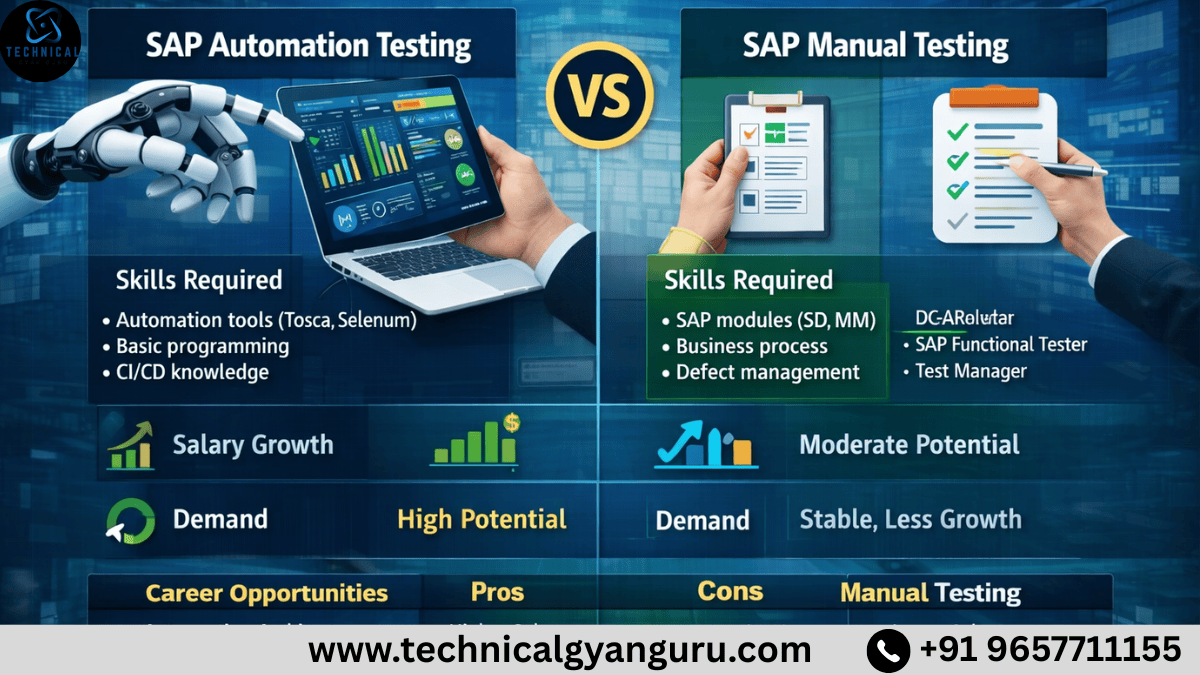
The SAP testing profession has changed more in the last few years than in the previous two decades. Organizations are moving faster, systems are becoming more complex, and business leaders expect stable releases with minimal risk. In this environment, the career path of SAP testers is clearly divided into two major directions. Manual testing and SAP automation testing. This detailed career comparison explains how both roles differ, how daily work looks in real projects, what skills are required, how salaries and growth paths evolve, and which career is more future ready in 2026 and beyond.
Why SAP Testing Careers Are Undergoing a Major Shift
SAP landscapes today include S4 systems, cloud platforms, integrated applications, mobile access and external partners. Every small change can impact multiple business processes. Manual testing alone can no longer protect organizations from business disruption.
Automation is being introduced not only to reduce testing effort but to support continuous delivery, frequent upgrades and compliance requirements. This shift is directly impacting how SAP testing professionals build their careers.
What Is Manual Testing in SAP Projects
Manual testing in SAP projects focuses on executing business scenarios step by step through transactions and user interfaces. Testers follow test scripts, validate outputs, compare results with expected values and record defects.
Typical responsibilities of a manual SAP tester
Understanding business processes such as procure to pay, order to cash and record to report
Preparing and executing test cases
Creating and maintaining test documentation
Logging and tracking defects
Supporting user acceptance testing
Communicating test results to project teams
Manual testing remains an important activity, especially for new business scenarios, usability validation and exploratory testing.
What Is SAP Automation Testing
SAP automation testing uses specialized tools and frameworks to execute test scenarios automatically without manual intervention. Automated scripts or components validate business processes, system integrations and application behavior.
Typical responsibilities of an SAP automation tester
Designing automated test scenarios based on business processes
Building and maintaining automation frameworks
Automating regression and smoke test suites
Integrating automation with deployment pipelines
Analyzing automation results and failures
Maintaining test data and execution environments
Automation testing focuses heavily on reusability, scalability and execution reliability.
Daily Work Comparison Manual Testing vs SAP Automation Testing
The daily routine of a manual tester and an automation tester is very different.
Daily work of a manual SAP tester
Manual testers usually begin their day by reviewing assigned test cases and test cycles. They log into SAP systems, execute transactions, validate screen outputs and compare data in tables and reports.
A large part of the day is spent waiting for data preparation, system availability and defect fixes before re testing.
Documentation and coordination with functional consultants and business users also consume significant time.
Daily work of an SAP automation tester
Automation testers spend most of their day designing, improving and maintaining automated test flows.
They analyze business processes, build reusable components, stabilize test execution and investigate automation failures.
They also integrate test execution with continuous integration systems and monitor nightly or on demand execution results.
Instead of repeating the same scenario manually, they focus on improving coverage and execution stability.
Skill Requirements Comparison
The skills required for both roles differ significantly.
Skills required for manual SAP testing careers
Strong understanding of business processes
Ability to understand functional specifications
Good documentation and communication skills
Attention to detail
Basic knowledge of SAP transactions and data flow
Manual testers must be strong business scenario validators.
Skills required for SAP automation testing careers
Good understanding of business processes and system behavior
Knowledge of automation tools and frameworks
Basic programming or scripting skills
Understanding of test design patterns and reusable components
Experience with test data management and execution pipelines
Analytical skills to identify automation failures and root causes
Automation testers must combine business knowledge with technical skills.
Learning Curve and Entry Barrier
The entry barrier is lower for manual testing compared to automation.
Manual testing learning curve
Beginners can start manual testing with limited technical background. With proper functional training and process understanding, they can contribute to projects quickly.
Automation testing learning curve
Automation requires understanding of tools, scripting logic, framework design and execution environments.
It usually takes more time for beginners to become productive, but the long term benefits are significantly higher.
Career Growth Opportunities
Career growth paths differ greatly between the two roles.
Career growth in manual SAP testing
Junior manual tester
Senior manual tester
Test lead or test coordinator
User acceptance testing coordinator
Business process tester
While growth exists, manual testers often reach a plateau unless they move into functional consulting or test management roles.
Career growth in SAP automation testing
Automation test engineer
Senior automation specialist
Automation architect
Test automation lead
Quality engineering manager
DevOps and quality transformation roles
Automation professionals can move into strategic quality and delivery roles that influence entire programs.
Salary and Market Demand Comparison
In 2026, market demand clearly favors automation testing professionals.
Demand for manual SAP testers
Manual testers are still required, especially for business acceptance testing and exploratory validation. However, organizations are reducing manual regression teams and focusing on smaller, more specialized groups.
Demand for SAP automation testers
Automation specialists are in high demand across global SAP programs. Organizations actively seek professionals who can build scalable automation frameworks and support continuous delivery.
Automation roles generally offer higher compensation due to specialized skills and strategic importance.
Job Stability and Long Term Relevance
Job stability is a major concern for many professionals.
Stability of manual testing careers
Manual testing will not disappear completely, but the scope of manual roles is shrinking.
Most organizations aim to automate repetitive and high volume testing scenarios. Manual roles are increasingly limited to complex validations and business acceptance.
Stability of SAP automation testing careers
Automation testing roles are expanding. As systems become more complex, organizations need experts who can design and maintain automated quality frameworks.
Automation professionals are less likely to be replaced because they continuously improve automation systems rather than performing repetitive tasks.
Impact of Automation on Manual Testing Roles
Automation does not eliminate manual testers, but it changes how they work.
Manual testers must shift toward business focused validation
Manual testers increasingly participate in test design, exploratory testing and business acceptance rather than repetitive execution.
Those who expand their skills into automation concepts and tools can transition into hybrid quality roles.
Real Project Example Manual vs Automation Testing Teams
In a global rollout project, a finance and logistics system had to be tested every month due to frequent configuration updates.
Initially, a large manual team executed hundreds of test cases during each release cycle. Testing cycles lasted two to three weeks and often delayed deployments.
Later, the organization introduced automated regression for all core processes.
Manual testers focused on validating new scenarios and business changes, while automation testers maintained the automated suites.
Testing cycles were reduced to a few days and release quality improved significantly.
This project clearly demonstrated how automation changes team structure and career roles.
Work Pressure and Stress Comparison
Manual testing pressure
Manual testers often face high pressure near go live and release dates. Long execution cycles, repetitive tasks and tight timelines create fatigue and burnout.
Automation testing pressure
Automation testers face different types of pressure. They are responsible for execution stability, tool maintenance and rapid failure analysis.
However, automation professionals generally have better control over execution timelines because test runs can be scheduled and scaled.
Creativity and Problem Solving Opportunities
Manual testing creativity
Manual testers mainly focus on validation and defect identification. Creativity is mostly applied during exploratory testing and scenario design.
Automation testing creativity
Automation professionals design test frameworks, optimize execution strategies and solve technical challenges.
They often work on innovative solutions such as self healing automation, data driven execution and pipeline integration.
Automation roles offer broader problem solving opportunities.
Transition Path from Manual to Automation Testing
Many professionals start their careers in manual testing and later move into automation.
Practical transition approach
Start learning automation concepts alongside manual work
Participate in automation projects as a shadow team member
Learn basic scripting and test framework structure
Understand how automated tests are designed and executed
Practice creating small automation components
This gradual transition helps manual testers move into higher value roles without disrupting their current careers.
Certification and Learning Investment Comparison
Manual testing learning investment
Manual testers mainly invest in functional training and business process certifications.
Automation testing learning investment
Automation professionals invest in tool certifications, scripting languages, test framework design and pipeline technologies.
Although learning investment is higher for automation, the long term return is significantly stronger.
Global Opportunities and Remote Work
Manual testing global opportunities
Manual testing roles are often location dependent because they involve business workshops and user interactions.
Automation testing global opportunities
Automation roles are more flexible and suitable for remote work. Many organizations build centralized automation teams supporting global projects.
This provides better international exposure and career mobility.
Risk of Skill Obsolescence
Risk for manual testing professionals
As automation coverage increases, manual execution skills alone may become insufficient to remain competitive.
Risk for automation testing professionals
Automation tools and frameworks evolve, but core automation concepts and quality engineering principles remain stable.
Professionals who continuously update their tool knowledge remain relevant.
Business Value Contribution Comparison
Business value from manual testing
Manual testers ensure correctness and usability of business scenarios. They provide valuable feedback during acceptance and process validation.
Business value from automation testing
Automation professionals protect business continuity by enabling rapid and reliable releases.
They directly contribute to faster deployments, reduced risk and improved operational stability.
Organizations increasingly measure quality success through automation coverage and execution reliability.
Which Career Is Better in 2026 and Beyond
There is no single answer for everyone, but market trends are clear.
Manual testing remains important for business acceptance and exploratory scenarios. However, long term growth, salary potential and job stability strongly favor SAP automation testing careers.
Professionals who combine business understanding with automation expertise become key contributors to transformation programs.
How to Choose the Right Career Path for Yourself
Choose manual testing if
You strongly enjoy business process validation
You prefer working closely with business users
You plan to move into functional consulting or business analysis roles
Choose SAP automation testing if
You enjoy technical problem solving and frameworks
You want long term career stability and global opportunities
You are interested in DevOps, quality engineering and transformation roles
You enjoy continuous learning and tool evolution
Actionable Tips for Building a Successful Career in SAP Testing
Build strong business process knowledge regardless of your role
Learn how SAP systems behave under configuration and data changes
Understand test design principles before focusing on tools
Invest in communication skills and stakeholder collaboration
If you are in manual testing, start learning automation gradually
If you are in automation, continue improving business understanding
Focus on quality engineering mindset rather than only test execution
you may be interested in this blog here:-
Landing Your Dream Job: The Ultimate Guide to SAP MM Consultant resume 3 years experience