
 Varad
Varad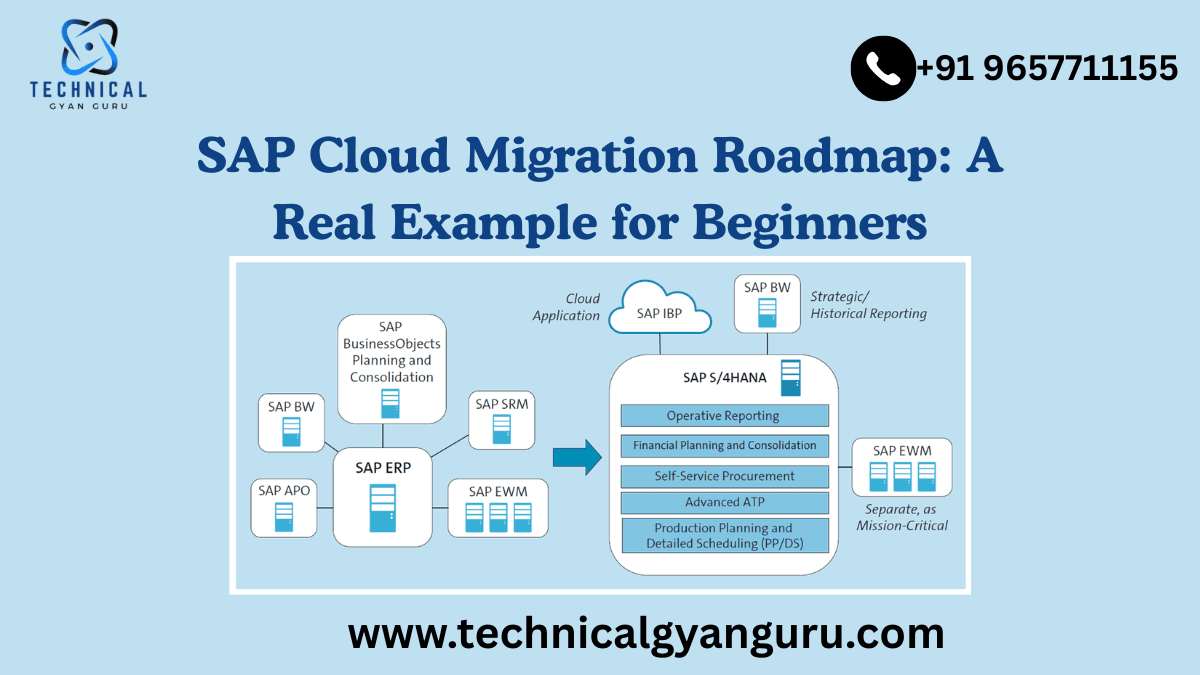
Introduction: Why SAP Cloud Migration Matters
Many organizations running SAP ECC systems are now at a turning point. With rising infrastructure costs, limited innovation, and SAP’s strategic focus on cloud solutions, businesses are actively planning their move to the cloud. However, cloud migration is not just a technical upgrade—it is a business transformation.
This is where a clear SAP Cloud Migration Roadmap becomes essential. It provides a structured plan to move from on-premise SAP systems to SAP S/4HANA Cloud with minimal risk and maximum value. In this blog, we will break down the SAP Cloud Migration Roadmap using a real-life example that beginners and professionals can easily understand.
What Is an SAP Cloud Migration Roadmap?
An SAP Cloud Migration Roadmap is a step-by-step strategy that guides organizations through the journey of moving their SAP systems, data, and processes to the cloud.
It answers key questions such as:
- Which SAP cloud model should we choose?
- How do we migrate data safely?
- What happens to custom code?
- How do we minimize business disruption?
Instead of a one-time activity, it is a phased approach that aligns IT goals with business objectives.
Why Companies Are Moving SAP to the Cloud
Organizations are choosing SAP cloud migration for several reasons.
Lower Infrastructure Costs
Cloud eliminates the need for expensive on-premise hardware and maintenance.
Faster Innovation
SAP releases new features faster in cloud versions, especially for S/4HANA Cloud.
Scalability and Flexibility
Cloud systems scale automatically based on business demand.
Improved Security and Compliance
Cloud providers invest heavily in security and compliance standards.
Types of SAP Cloud Migration Approaches
Before looking at the roadmap, it’s important to understand the common migration approaches.
System Conversion
Existing SAP ECC system is converted into SAP S/4HANA.
Selective Data Transition
Only selected processes and historical data are migrated.
New Implementation
A fresh SAP S/4HANA Cloud system is implemented from scratch.
The roadmap can be applied to any of these approaches with slight variations.
Real Example: Mid-Sized Manufacturing Company
Company Background
A mid-sized manufacturing company is running SAP ECC 6.0 on-premise for finance, materials management, sales, and production. The system has been live for 12 years with heavy customizations.
Business Challenges
- High infrastructure and maintenance costs
- Slow reporting and analytics
- Difficulty integrating with modern cloud applications
- Upcoming ECC support limitations
Migration Goal
Move to SAP S/4HANA Public Cloud to reduce costs, improve performance, and enable real-time analytics.
Phase 1: Discovery and Assessment
System Landscape Analysis
The IT team analyzes the existing SAP ECC landscape, including modules, interfaces, custom code, and data volume.
Business Process Review
Key business users review current processes to identify inefficiencies and opportunities for standardization.
Readiness Check
SAP Readiness Check tools are used to evaluate technical compatibility with S/4HANA Cloud.
Outcome
A clear understanding of system complexity, risks, and migration feasibility.
Phase 2: Strategy and Planning
Choosing the Right Cloud Model
The company selects SAP S/4HANA Public Cloud to benefit from lower costs and standardized best practices.
Defining Migration Approach
A selective data transition is chosen to reduce complexity and clean up legacy data.
Project Roadmap Creation
A detailed project plan is created, including timelines, responsibilities, and milestones.
Outcome
A well-defined SAP Cloud Migration Roadmap aligned with business goals.
Phase 3: Preparation and System Readiness
Custom Code Adaptation
Unnecessary custom programs are removed, and essential ones are redesigned using SAP-recommended practices.
Data Cleansing
Old and redundant data is archived to reduce migration effort.
Infrastructure Setup
Cloud environments are provisioned, and security roles are designed.
Outcome
A clean and optimized system ready for migration.
Phase 4: Migration Execution
Data Migration
Master data and selected transactional data are migrated using SAP migration tools.
Process Configuration
Business processes are configured in SAP S/4HANA Cloud using best-practice content.
Integration Setup
Connections with third-party systems and SAP BTP services are established.
Outcome
Core business processes are live in the cloud system.
Phase 5: Testing and Validation
Functional Testing
Business users validate end-to-end processes such as order-to-cash and procure-to-pay.
Integration Testing
Interfaces with external systems are tested for accuracy and performance.
User Acceptance Testing
End users confirm that the system meets business requirements.
Outcome
A stable and validated SAP cloud system.
Phase 6: Go-Live and Post-Migration Optimization
Go-Live Support
The system is officially switched to production with dedicated support teams.
Performance Monitoring
System performance and usage are monitored closely.
Continuous Improvement
Additional cloud features and innovations are gradually enabled.
Outcome
A successful SAP cloud transformation with continuous optimization.
Key Tools Used in SAP Cloud Migration
SAP Readiness Check
SAP Migration Cockpit
SAP Business Technology Platform
SAP Activate Methodology
Common Challenges and How to Overcome Them
Resistance to Change
Addressed through training and change management.
Custom Code Complexity
Solved by redesigning processes using standard SAP best practices.
Data Quality Issues
Resolved with early data cleansing and validation.
Skills Needed for SAP Cloud Migration Projects
SAP S/4HANA Functional Knowledge
Cloud Architecture Basics
Data Migration Concepts
Integration and Security Fundamentals
These skills are increasingly in demand as more companies move to SAP cloud solutions.
Conclusion: Why a Roadmap Is the Key to Success
A successful SAP cloud journey does not happen by accident. It requires a clear SAP Cloud Migration Roadmap that balances technical readiness with business transformation. By following a structured approach and learning from real examples, organizations can reduce risk, control costs, and unlock the full potential of SAP cloud solutions.
For beginners, understanding this roadmap builds a strong foundation for a future-ready SAP career.
CALL TO ACTION (CTA)
Want to build a career in SAP Cloud and S/4HANA?
Explore step-by-step SAP Cloud Migration courses, hands-on projects, and certification guides to gain real-world expertise and stay ahead in the SAP ecosystem.
Take your next step toward becoming a cost-smart SAP professional today!