
 Varad
Varad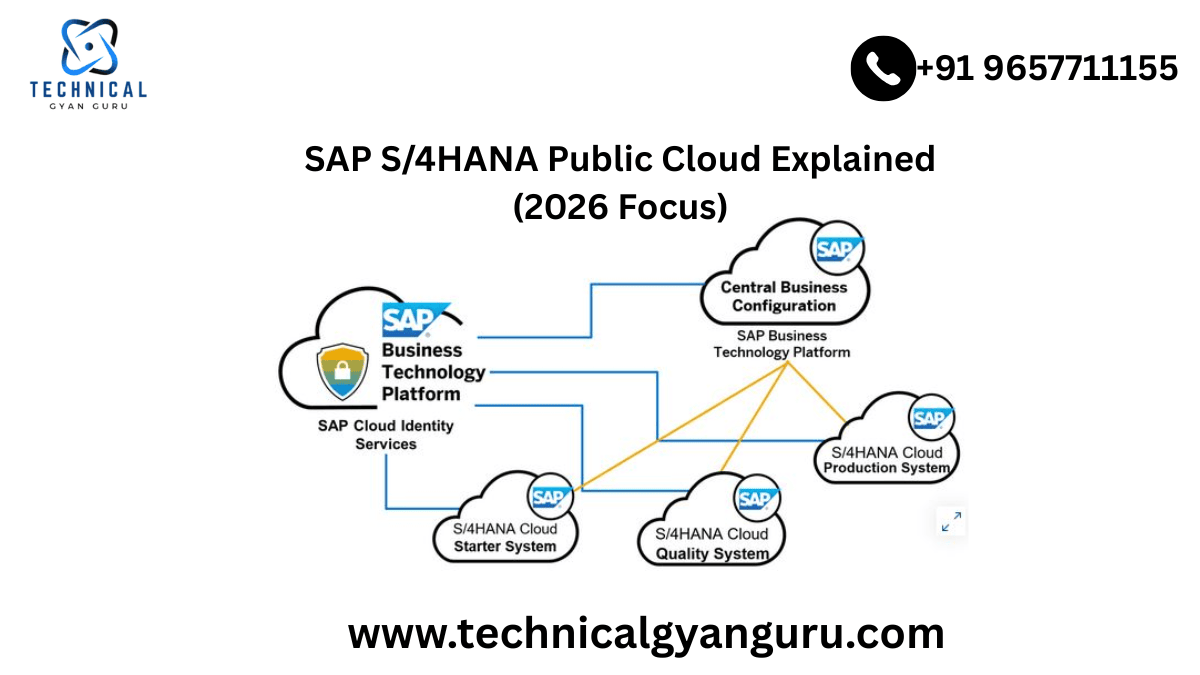
Enterprise software is undergoing a major shift, and SAP is at the center of this transformation. As organizations prepare for the future, SAP S/4HANA Public Cloud is becoming a preferred choice for companies that want speed, innovation, and lower operational complexity.
With 2026 approaching fast, businesses, IT professionals, and fresh learners are asking an important question: What exactly is SAP S/4HANA Public Cloud, and why is it gaining so much attention?
This guide explains SAP S/4HANA Public Cloud in simple terms, with real-world examples, use cases, and trends shaping its adoption.
What Is SAP S/4HANA Public Cloud?
SAP S/4HANA Public Cloud is SAP’s Software-as-a-Service (SaaS) ERP solution hosted and fully managed by SAP. Unlike traditional on-premise ERP systems, it runs entirely on the cloud and follows a standardized, best-practice-driven approach.
In simple words, SAP provides the system, infrastructure, upgrades, and security—while businesses focus on running operations.
Why SAP Is Pushing Public Cloud ERP
SAP’s long-term roadmap strongly favors cloud-first innovation. By 2026, most new SAP innovations will be delivered primarily through cloud platforms.
Key reasons include:
- Faster innovation cycles
- Lower IT maintenance
- Built-in AI and analytics
- Global scalability
SAP S/4HANA Public Cloud aligns perfectly with modern digital transformation goals.
How SAP S/4HANA Public Cloud Works
SAP S/4HANA Public Cloud operates on a multi-tenant architecture, meaning multiple customers share the same system instance while keeping data fully isolated and secure.
SAP delivers:
- Quarterly upgrades
- Standardized business processes
- Embedded analytics
- AI-driven insights
This ensures customers always stay on the latest version without complex upgrades.
Key Features of SAP S/4HANA Public Cloud
SAP S/4HANA Public Cloud offers powerful features designed for modern enterprises.
Ready-to-Run Business Processes
SAP provides preconfigured best-practice business processes for finance, procurement, sales, manufacturing, and supply chain.
Example: A startup can activate finance and procurement modules within weeks instead of months.
Continuous Innovation and Updates
Quarterly releases bring:
- New features
- Security enhancements
- Performance improvements
This eliminates the need for large upgrade projects.
Embedded Analytics and AI
SAP S/4HANA Public Cloud includes:
- Real-time reporting
- Predictive analytics
- AI-driven recommendations
Finance teams can instantly analyze cash flow, expenses, and profitability.
Scalability and Global Reach
Whether a company has 50 users or 50,000, SAP S/4HANA Public Cloud scales seamlessly across regions.
SAP S/4HANA Public Cloud vs Private Cloud
Understanding the difference is crucial.
Public Cloud:
- Standardized processes
- Faster implementation
- Lower cost
- Limited customization
Private Cloud:
- More flexibility
- Higher customization
- Longer implementation
- Higher cost
Public Cloud is ideal for organizations prioritizing speed and innovation.
Who Should Choose SAP S/4HANA Public Cloud?
SAP S/4HANA Public Cloud is best suited for:
- Small and mid-sized enterprises
- Fast-growing startups
- Companies moving from legacy ERP
- Businesses adopting clean-core strategy
Enterprises seeking heavy customization may prefer private cloud, but many are shifting toward public cloud for agility.
Real-World Example
A mid-sized manufacturing company wants to expand globally.
Traditional ERP approach:
- Long implementation
- High infrastructure cost
- Complex upgrades
SAP S/4HANA Public Cloud approach:
- Live within months
- Built-in compliance
- Continuous innovation
This is why adoption is accelerating.
Clean Core Strategy and Public Cloud
SAP promotes a clean core strategy, meaning:
- Minimal custom code
- Use of extensions via SAP BTP
- Easier upgrades
- Lower technical debt
SAP S/4HANA Public Cloud is designed entirely around this philosophy.
Role of SAP Business Technology Platform (BTP)
Customization still exists—but outside the core.
SAP BTP allows:
- Extensions
- Integrations
- Custom apps
- Automation
This keeps the core ERP stable while allowing flexibility.
Industry Trends Driving Adoption in 2026
Several trends are shaping SAP S/4HANA Public Cloud growth.
AI-Driven ERP
AI-powered forecasting, invoice processing, and decision support are becoming standard features.
Regulatory Compliance Automation
Public cloud ERP helps businesses stay compliant across regions automatically.
Subscription-Based IT Models
Companies prefer predictable subscription costs over heavy capital expenditure.
Benefits for Employees and Teams
Employees benefit through:
- Simplified user experience
- SAP Fiori-based UI
- Faster task execution
- Mobile accessibility
This improves productivity and user adoption.
Challenges to Be Aware Of
SAP S/4HANA Public Cloud also has limitations.
Common challenges:
- Limited deep customization
- Dependency on SAP release cycles
- Process standardization requirement
Organizations must be ready to adapt processes rather than customize heavily.
Skills Demand and Career Opportunities
By 2026, demand for professionals skilled in SAP S/4HANA Public Cloud will rise sharply.
High-demand roles include:
- SAP Functional Consultants
- SAP Integration Specialists
- SAP BTP Developers
- Cloud ERP Architects
Learning public cloud skills offers strong career growth.
Getting Started with SAP S/4HANA Public Cloud
Beginners should start by:
- Understanding core ERP concepts
- Learning SAP best practices
- Exploring SAP Activate methodology
- Practicing on cloud demos
This builds a strong foundation.
Final Thoughts
SAP S/4HANA Public Cloud is not just another ERP deployment option—it represents SAP’s future vision for intelligent, scalable, and cloud-first enterprise systems.
As 2026 approaches, businesses and professionals who embrace this model early will gain a significant competitive advantage.
Call to Action
Want to future-proof your SAP career or business?
Explore SAP S/4HANA Public Cloud training, hands-on demos, and guided learning paths to stay ahead in the evolving SAP ecosystem.
Explore our curated courses on:
- SAP S/4HANA Migration for Beginners
- RISE with SAP Explained
- SAP Signavio and Business Process Intelligence
- Conclusion
- Building Cloud-Native ABAP Applications: A Guide to Modern SAP Development
- Parallel cursor in SAP ABAP
- How to Create RAP business events in SAP BTP ABAP Environment ?