
 Varad
Varad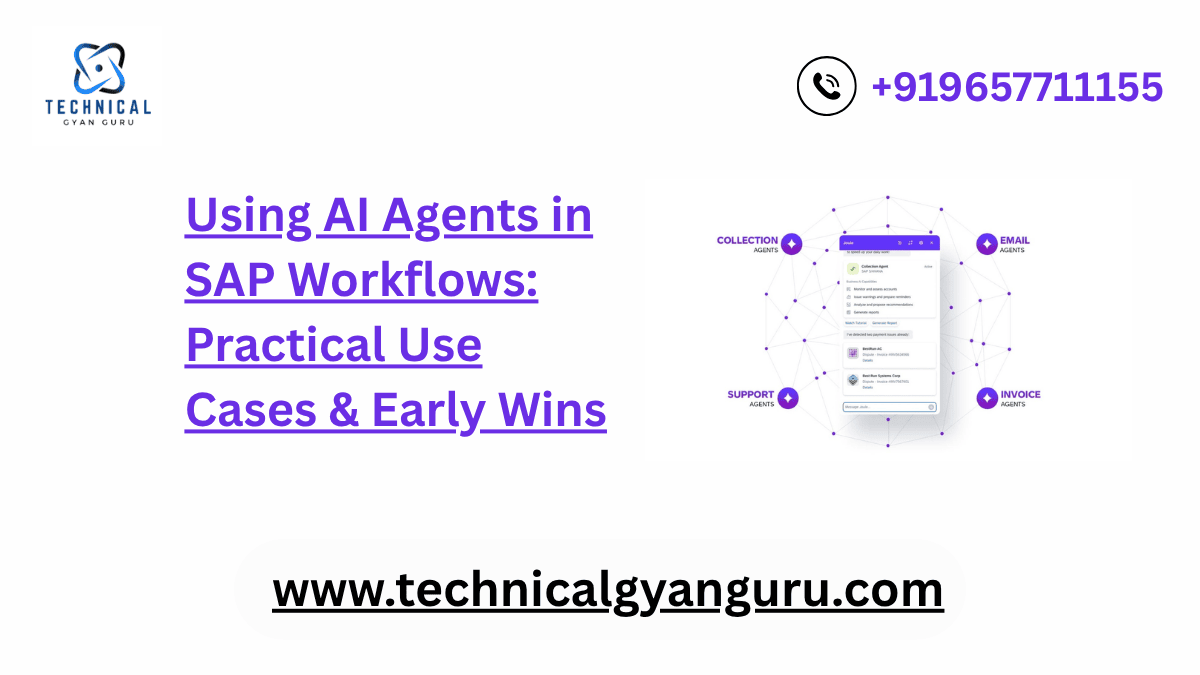
Artificial Intelligence is no longer a futuristic concept—it’s a business imperative. Across industries, companies are racing to integrate AI into their operations to drive efficiency, accuracy, and growth. For SAP users, this shift is especially transformative. With the arrival of AI agents in SAP workflows, organizations are beginning to unlock unprecedented levels of automation and intelligence across their systems. What used to take hours of manual intervention can now be executed autonomously in seconds, allowing employees to focus on higher-value work.
SAP’s journey toward intelligent automation has been building momentum for years, and AI agents represent the next natural step. These intelligent assistants don’t just perform routine tasks—they learn, adapt, and make decisions within the context of complex business processes. Whether it’s automating invoice approvals, predicting supply chain disruptions, or optimizing workforce planning, AI agents in SAP workflows are proving to be game-changers.
The Rise of AI Agents Within SAP
SAP’s integration of AI has evolved significantly, especially with innovations like SAP Business AI and Joule, the AI copilot embedded within SAP’s ecosystem. These tools enable users to interact with their systems using natural language, automate repetitive actions, and access predictive insights without deep technical knowledge.
AI agents, however, go a step further. They act as autonomous digital workers that can perform tasks, trigger workflows, and make context-based decisions across multiple SAP modules. In essence, they bridge the gap between human intent and system execution. Unlike static automation tools or bots, AI agents learn from patterns, understand business logic, and continuously refine their performance.
For instance, an AI agent in a procurement workflow can identify when a supplier consistently delivers late, automatically adjust delivery timelines, or even recommend alternate vendors based on historical data. These actions, once manual and time-consuming, now occur instantly and intelligently.
Understanding How AI Agents Fit into SAP Workflows
Traditional SAP workflows are structured, rule-based sequences of actions. They follow defined triggers—such as an order creation or invoice submission—to move a process along its path. While efficient, these workflows are limited by their rigidity. AI agents introduce flexibility and intelligence into this structure, enabling adaptive workflows that can respond dynamically to changing conditions.
Think of them as digital team members. They can analyze data, anticipate issues, suggest actions, or even execute them autonomously within SAP environments like SAP S/4HANA, SAP SuccessFactors, SAP Ariba, and SAP Fieldglass.
A simple example is the automation of expense management. Instead of waiting for manual approvals, an AI agent can validate claims against company policies, detect anomalies, and approve or escalate based on context. In financial closing processes, AI agents can automatically reconcile accounts, identify outliers, and generate reports for review—reducing end-of-month workloads dramatically.
Real-World Use Cases Delivering Early Wins
The potential of AI agents in SAP workflows extends across departments and industries. Early adopters are already seeing measurable improvements in efficiency, accuracy, and cost savings.
In finance, AI agents handle routine journal entries, match payments, and monitor compliance in real time. By automating repetitive accounting functions, companies report faster closing cycles and reduced human error. For example, an SAP-integrated AI agent can analyze thousands of invoices daily, detect discrepancies, and initiate corrective actions automatically—something that once required dedicated teams.
In procurement and supply chain management, AI agents are redefining how organizations respond to volatility. When an AI agent detects a shortage in supplier deliveries, it can automatically trigger alternate sourcing, adjust purchase orders, or alert managers about potential disruptions. This proactive decision-making helps avoid costly downtime and maintains business continuity.
In HR and talent management, AI agents within SAP SuccessFactors help screen resumes, match candidates to open roles, and streamline onboarding processes. They can even track employee engagement metrics and predict attrition risks, empowering HR teams to act before issues escalate.
Sales and marketing teams, too, benefit from these intelligent tools. Integrated with SAP Customer Experience (CX), AI agents can recommend personalized offers, automate lead nurturing, and forecast sales trends based on past performance. As a result, customer interactions become more targeted, and sales cycles shorten.
Why AI Agents Are Transforming SAP Efficiency
What makes AI agents truly revolutionary is their ability to connect data, context, and action. SAP systems generate enormous volumes of data daily—financial transactions, operational metrics, customer interactions, and more. Historically, much of this data remained underutilized due to siloed systems or manual analysis limitations. AI agents now unlock this potential by continuously analyzing data patterns and transforming them into real-time insights and actions.
For businesses, this means faster decision-making and greater accuracy. Managers no longer have to sift through dashboards or reports to find what needs attention. Instead, AI agents surface key insights proactively—alerting teams about anomalies, forecasting outcomes, and recommending corrective measures.
This shift from reactive to proactive operations creates a new standard of agility. Whether it’s optimizing inventory levels, preventing fraud, or improving cash flow visibility, AI-driven workflows ensure businesses stay ahead of challenges rather than respond to them after the fact.
How to Begin Implementing AI Agents in SAP Workflows
Adopting AI agents doesn’t require a full-scale overhaul of existing SAP environments. In fact, SAP’s modular architecture and cloud-first approach make integration easier than ever. The best starting point is to identify repetitive, rule-based processes that consume time and resources—such as purchase order approvals, data reconciliation, or employee onboarding. These are prime candidates for early automation wins.
Next, organizations should explore the AI capabilities already embedded within their SAP ecosystem. Tools like SAP Business Technology Platform (BTP) allow companies to build, deploy, and manage AI models seamlessly. SAP’s AI Core and AI Launchpad, for instance, enable the creation of custom agents tailored to specific business needs.
It’s also essential to foster collaboration between IT and business users. AI agents thrive on contextual understanding, and the most successful implementations occur when technical experts and process owners co-design workflows. Training and change management are equally important—employees should see AI agents as supportive tools, not replacements.
Early Success Stories and Industry Trends
Organizations across industries are already reporting strong returns from integrating AI agents into SAP workflows. A global manufacturing firm reduced its procurement cycle time by 40% after deploying AI agents to manage vendor communications and purchase order tracking. A logistics company using AI in SAP S/4HANA automated its freight cost validation process, saving hundreds of man-hours monthly.
In the energy sector, AI agents monitor equipment performance data within SAP, automatically scheduling maintenance before breakdowns occur—minimizing downtime and maximizing asset efficiency. Meanwhile, retail businesses leverage AI-driven insights from SAP Customer Data Cloud to optimize pricing and promotions in real time.
These success stories underscore a key takeaway: organizations that invest early in AI-driven automation are achieving faster ROI and gaining a competitive edge in their markets. As the technology matures, the gap between adopters and laggards will only widen.
The Road Ahead: From Automation to Autonomy
Looking forward, the role of AI agents in SAP workflows will continue to expand. We’re moving from task automation toward full process autonomy, where AI agents will not only execute workflows but also design and optimize them based on evolving business goals.
SAP’s roadmap emphasizes this transformation. With AI copilots like Joule and advancements in Generative AI, professionals will soon interact with SAP systems conversationally—asking questions, assigning tasks, and generating reports through natural language. The integration of generative capabilities will make workflows more intuitive, intelligent, and human-centric.
This evolution will also redefine roles across organizations. Employees will shift from performing manual, transactional work to managing strategy, creativity, and problem-solving—while AI handles the operational complexity. Businesses that embrace this human-AI collaboration model will thrive in the next era of digital transformation.
Taking the First Step Toward AI-Driven Success
For companies and professionals alike, now is the ideal time to explore AI agents in SAP workflows. The technology is mature, the infrastructure is ready, and the benefits are undeniable. By starting with targeted pilot projects and scaling strategically, businesses can build momentum and confidence in their AI journey.
Whether your goal is to reduce manual workload, improve decision-making, or enhance customer experience, AI agents offer a powerful way forward. Their ability to learn, adapt, and collaborate across systems makes them indispensable assets in the modern enterprise landscape.
If you’re ready to dive deeper into how AI can transform your SAP environment, explore our collection of expert-led guides, tutorials, and online courses on integrating AI agents into business workflows. The future of intelligent automation is already here—those who act today will define the success stories of tomorrow.
YOU MAY BE INTERESTED IN
10 Real-World SAP ABAP Programming Examples (with Code!)
Your Definitive Guide to Becoming a SAP ABAP Developer