
 Varad
Varad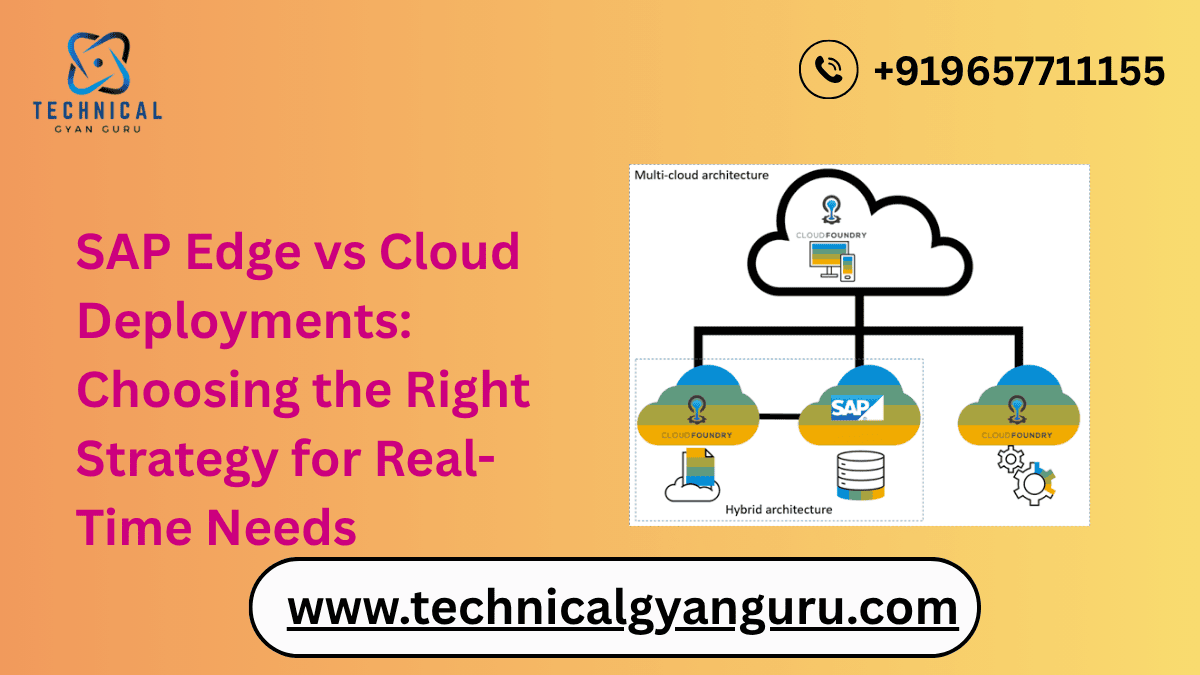
Technology today is not just about innovation—it’s about speed, agility, and adaptability. Businesses can no longer afford to wait hours (or even minutes) for critical insights when decisions must be made in real time. This is especially true in industries like manufacturing, retail, logistics, and finance, where every second counts.
This brings us to a key decision many organizations face: Should you deploy SAP solutions on the edge or in the cloud?
For beginners and professionals alike, the terms “edge” and “cloud” can sound intimidating. But don’t worry—in this blog, we’ll break them down in simple terms, explore the differences, discuss real-world applications, and help you decide which deployment strategy is best for your business.
What Do We Mean by Edge and Cloud?
Let’s start with the basics:
- Edge Deployment
Edge computing brings data processing and analytics closer to where the data is generated—whether it’s on a factory floor, a retail store, or a delivery vehicle. Instead of sending everything to a distant data center, edge computing enables immediate processing at the “edge” of the network. - Cloud Deployment
Cloud computing relies on centralized, internet-connected servers hosted by cloud providers like AWS, Azure, or SAP’s own Business Technology Platform (BTP). It offers scalability, flexibility, and access to powerful computing resources without heavy on-site infrastructure.
Think of edge as your smartphone calculator—quick, local, and always ready—and cloud as an online supercomputer—powerful, global, but dependent on connectivity.
Why Does the Choice Between Edge and Cloud Matter?
In today’s digital economy, data is like gold. But how fast you process it and where you store it determines your ability to compete.
- Real-time decision-making: A machine on the factory line detecting a fault needs instant action—this is edge.
- Scalability and global insights: A retail chain analyzing buying patterns across continents needs cloud.
- Compliance and data sovereignty: Some industries must keep data within a country—this impacts the choice.
Making the right choice between edge and cloud deployment can save costs, reduce downtime, and improve compliance.
SAP Edge Deployment: Key Benefits and Use Cases
SAP has embraced edge computing as part of its Intelligent Enterprise vision. Here’s why edge deployment is powerful:
Benefits of SAP Edge:
- Low Latency: Data is processed instantly, enabling real-time responses.
- Reduced Bandwidth Costs: Not all data needs to be sent to the cloud, saving costs.
- Data Privacy: Sensitive data can stay on-site, supporting compliance.
- Resilience: Even if internet connectivity fails, operations continue.
Real-World Applications:
- Manufacturing: A factory uses SAP Edge to monitor machine health and prevent downtime without sending gigabytes of sensor data to the cloud.
- Retail: Stores use edge computing for real-time inventory updates to avoid stockouts.
- Energy: Power grids process load data at the edge to prevent blackouts.
SAP Cloud Deployment: Key Benefits and Use Cases
Cloud remains the backbone of digital transformation. SAP’s cloud-based solutions, particularly SAP S/4HANA Cloud and SAP Business Technology Platform (BTP), make global operations seamless.
Benefits of SAP Cloud:
- Scalability: Add resources as your business grows.
- Global Collaboration: Access systems from anywhere, anytime.
- Advanced Analytics: Harness AI, machine learning, and big data.
- Lower IT Maintenance: No need to manage physical servers.
Real-World Applications:
- Finance: A multinational uses SAP S/4HANA Cloud to unify accounting across regions.
- Healthcare: Hospitals analyze patient trends using SAP Cloud while keeping patient privacy intact.
- Logistics: Supply chains connect seamlessly across borders with real-time visibility.
SAP Edge vs Cloud: Side-by-Side Comparison
| Feature | SAP Edge Deployment | SAP Cloud Deployment |
| Speed | Instant, real-time (low latency) | Fast, but dependent on internet |
| Data Processing | Local, at the source | Centralized, remote servers |
| Cost | Higher initial setup, lower bandwidth cost | Lower setup, ongoing subscription |
| Scalability | Limited to local infrastructure | Virtually limitless |
| Resilience | Works offline | Needs stable internet |
| Best For | Real-time monitoring, compliance-heavy industries | Global operations, advanced analytics |
Hybrid Approach: The Best of Both Worlds
For many companies, the answer is not edge OR cloud—it’s edge AND cloud. SAP supports hybrid models where businesses can:
- Use edge computing for real-time local decisions, and
- Rely on cloud computing for global insights and long-term planning.
Example: An automotive company might use SAP Edge for real-time vehicle diagnostics and SAP Cloud for predictive analytics on fleet performance worldwide.
Market Trends in 2025
The demand for edge and cloud is accelerating in different directions:
- Edge on the Rise: IDC predicts that by 2026, 50% of new enterprise IT infrastructure will be deployed at the edge.
- Cloud Dominance: Gartner reports that 95% of new digital workloads will run in the cloud by 2025.
- Hybrid Reality: Most businesses will combine both strategies for flexibility and compliance.
Clearly, SAP’s strategy is future-ready, empowering companies to mix edge and cloud to fit their real-time needs.
Practical Tips for Choosing Your Deployment Strategy
- Assess Business Needs: Do you need split-second responses (edge) or large-scale insights (cloud)?
- Consider Compliance: Check local data laws—edge may be necessary.
- Budget Wisely: Edge requires upfront investment, cloud spreads costs monthly.
- Think Long-Term: Hybrid models are often the safest bet.
- Train Employees: Success depends on people as much as technology—invest in training on SAP edge and cloud solutions.
Conclusion
Choosing between SAP Edge and Cloud deployments is not about picking one “winner.” Instead, it’s about understanding your business goals, industry needs, and compliance requirements.
- If speed and local control are critical—Edge is your ally.
- If scalability and global integration matter—Cloud is your strength.
- And if you want resilience and flexibility—Hybrid is your best bet.