
 Varad
Varad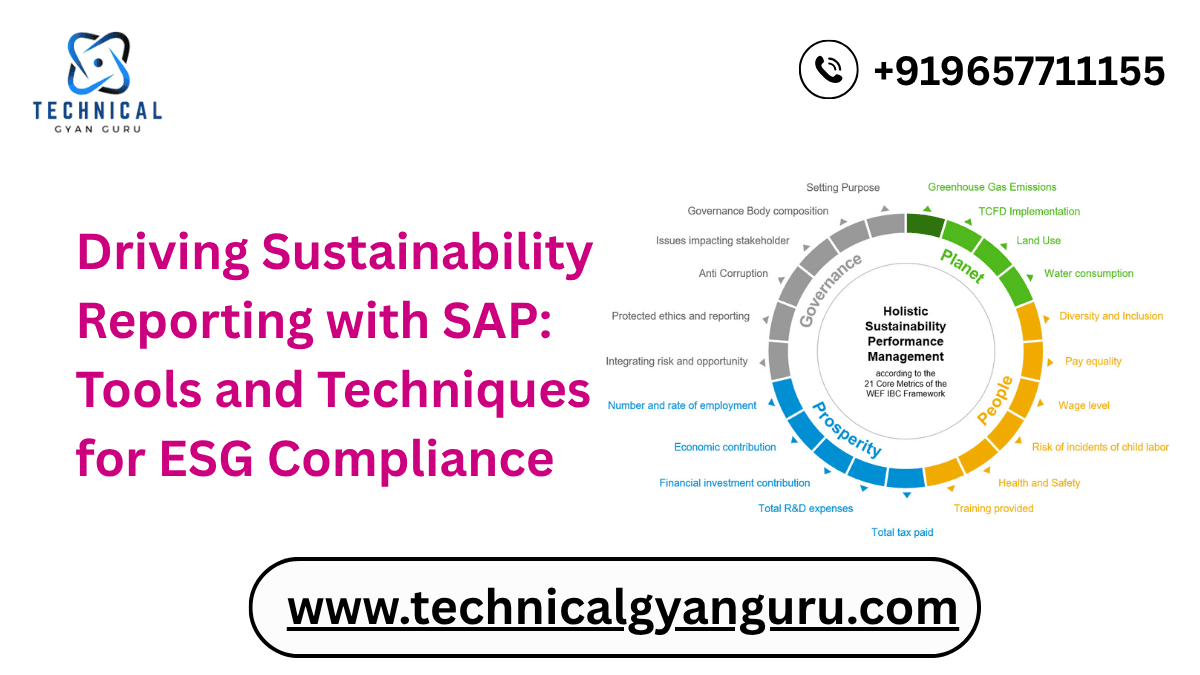
In today’s world, sustainability is no longer a buzzword—it’s a business necessity. Companies are under growing pressure from investors, customers, regulators, and employees to demonstrate their commitment to environmental, social, and governance (ESG) standards. But here’s the challenge: managing sustainability data is complex, and reporting it accurately can be overwhelming without the right tools.
This is where SAP’s sustainability solutions step in. By combining advanced reporting tools with integrated ESG compliance techniques, SAP empowers organizations to track, measure, and share sustainability progress with confidence.
If you’re new to ESG reporting or exploring how SAP can help, this beginner-friendly guide will break down the fundamentals, market insights, real-world use cases, and practical tips to get started.
What is ESG Reporting and Why Does It Matter?
ESG stands for Environmental, Social, and Governance—three key areas where businesses are evaluated for their long-term sustainability.
- Environmental (E): Carbon footprint, renewable energy use, waste management, water efficiency.
- Social (S): Employee welfare, diversity and inclusion, community impact, labor rights.
- Governance (G): Ethics, compliance, data protection, board accountability.
In 2025, ESG reporting is not just about compliance—it’s about building trust, attracting investment, and future-proofing your business. Research shows that companies with strong ESG performance often outperform their peers financially, because they are better at managing risks and opportunities.
Why SAP for Sustainability Reporting?
SAP has emerged as a leader in integrated ESG and sustainability management. Here’s why businesses choose SAP tools:
- Data Integration Across the Enterprise – SAP connects financial, operational, and sustainability data into one platform, reducing data silos.
- Regulatory Compliance – Built-in frameworks for global standards such as GRI (Global Reporting Initiative), CSRD (Corporate Sustainability Reporting Directive), and SASB (Sustainability Accounting Standards Board).
- Real-Time Insights – With SAP, you can monitor sustainability metrics in real time, not just during annual reporting cycles.
- Future-Ready Innovation – AI, machine learning, and cloud-native solutions power predictive insights for sustainable growth.
Tools for Sustainability Reporting in SAP
SAP offers a range of tools that simplify ESG reporting and compliance. Let’s break them down:
1. SAP Sustainability Control Tower
This is the central hub for sustainability performance management. It provides:
- Unified dashboards for ESG metrics.
- Regulatory reporting templates.
- Data lineage for audit transparency.
Example: A manufacturing company can track its carbon footprint in real time and align it with CSRD regulations using the Control Tower.
2. SAP Environment, Health, and Safety (EHS) Management
This tool helps organizations track and manage environmental impacts:
- Monitor emissions, waste, and hazardous materials.
- Ensure workplace safety and regulatory compliance.
- Automate incident reporting for transparency.
3. SAP Product Footprint Management
Perfect for businesses wanting to measure the environmental footprint of products:
- Calculate CO₂ emissions across the value chain.
- Provide data for sustainable procurement.
- Help design eco-friendly products.
4. SAP Responsible Design and Production (RDP)
This tool ensures businesses comply with circular economy regulations:
- Track packaging materials.
- Report on extended producer responsibility.
- Promote sustainable supply chain practices.
5. SAP Datasphere for ESG Data Integration
With data coming from multiple systems, SAP Datasphere provides:
- A single version of truth for ESG data.
- Integration of financial and non-financial reporting.
- Advanced analytics for trend forecasting.
Best Practices for ESG Compliance with SAP
To get the most out of SAP tools, companies should adopt these best practices:
1. Start with Materiality
Focus on the most critical ESG issues for your industry—whether it’s emissions in manufacturing, labor rights in supply chains, or data security in finance.
2. Establish Clear Data Governance
- Assign data stewards for ESG data.
- Use SAP Datasphere to track data lineage and ensure accuracy.
3. Automate Data Collection
Manual reporting leads to errors. Automating data flows with SAP tools ensures consistency and efficiency.
4. Benchmark Performance
Use SAP’s predictive analytics to compare your sustainability performance against industry peers and identify improvement areas.
5. Make ESG Everyone’s Responsibility
Sustainability is not just the job of a compliance team—it must be embedded into everyday business decisions. Train employees to use ESG dashboards and understand their role in the bigger picture.
Real-World Applications of SAP for ESG
- Retail: A global fashion retailer uses SAP Product Footprint Management to reduce emissions across its supply chain and meet carbon neutrality goals.
- Energy: An oil and gas company leverages SAP EHS Management to ensure compliance with environmental regulations and minimize ecological risks.
- Finance: Banks and financial institutions use SAP Sustainability Control Tower to track social and governance metrics for investor transparency.
- Technology: Tech firms integrate ESG reporting into SAP Datasphere to provide real-time dashboards for stakeholders.
Market Trends in 2025: ESG on the Rise
The push for sustainability is accelerating in 2025. Key trends include:
- Mandatory ESG Reporting: By 2026, most large companies in Europe and many global markets must comply with CSRD.
- Investor Demand: ESG-focused funds are attracting record investments, pressuring companies to improve transparency.
- AI-Driven ESG Analytics: Artificial intelligence is transforming how companies predict sustainability outcomes and risks.
- Supply Chain Sustainability: More businesses are extending ESG compliance to their suppliers and partners.
Practical Tips for Beginners
- Start with One Area: Don’t try to measure everything at once. Begin with carbon emissions or workforce diversity.
- Leverage SAP Templates: SAP provides ready-to-use compliance templates—use them to save time.
- Train Your Team: Offer workshops so employees can interpret ESG dashboards.
- Focus on Long-Term Value: ESG is not just compliance; it’s about building resilience and attracting future investments.
Conclusion
Sustainability reporting is no longer a “nice-to-have.” In 2025, it’s a business-critical priority. With SAP’s suite of sustainability tools, organizations can move beyond basic compliance to build a culture of transparency, accountability, and innovation.
For beginners, the journey may seem complex, but the rewards—stronger trust, compliance, and long-term success—are worth it. By embracing SAP’s sustainability solutions, companies can not only meet ESG requirements but also drive meaningful change for a better future.
🌍 Ready to make sustainability your superpower? Explore our advanced courses on SAP sustainability and ESG compliance today to future-proof your career and organization.
- Building Cloud-Native ABAP Applications: A Guide to Modern SAP Development
- Parallel cursor in SAP ABAP
- How to Create RAP business events in SAP BTP ABAP Environment ?
Also Read | SAP course price in Pune
Also Read | SAP course price in Pune
Also Read | SAP course price in Pune
Also Read | SAP course price in Pune